






Send Message
Privacy statement: Your privacy is very important to Us. Our company promises not to disclose your personal information to any external company with out your explicit permission.
 Shenzhen Hong Ye Jie Technology Co., Ltd
English
In recent years, carbon fiber composite applications in wind blade components, automotive carbon parts, yacht hulls, sports equipment and aerospace auxiliary materials have continued to expand, raising higher requirements on the stability and durability of tooling and auxiliary materials. In vacuum infusion and autoclave processes, the vacuum bag is one of the most critical consumables. It must apply uniform pressure under negative pressure, evacuate excess resin and bubbles, and maintain airtightness during heated curing. Although disposable vacuum film has a lower unit cost, each molding cycle consumes large amounts of film with high damage rates, and bridging, wrinkling and leakage often occur at complex curved surfaces, causing defects such as resin-rich areas and excessive porosity. Long-term comprehensive loss cost is therefore not low. Reusable silicone vacuum bags, with flexible conformability, repeated use and easy repair, are gradually replacing disposable film. Vacuum bag mold silicone enjoys broad application prospects.
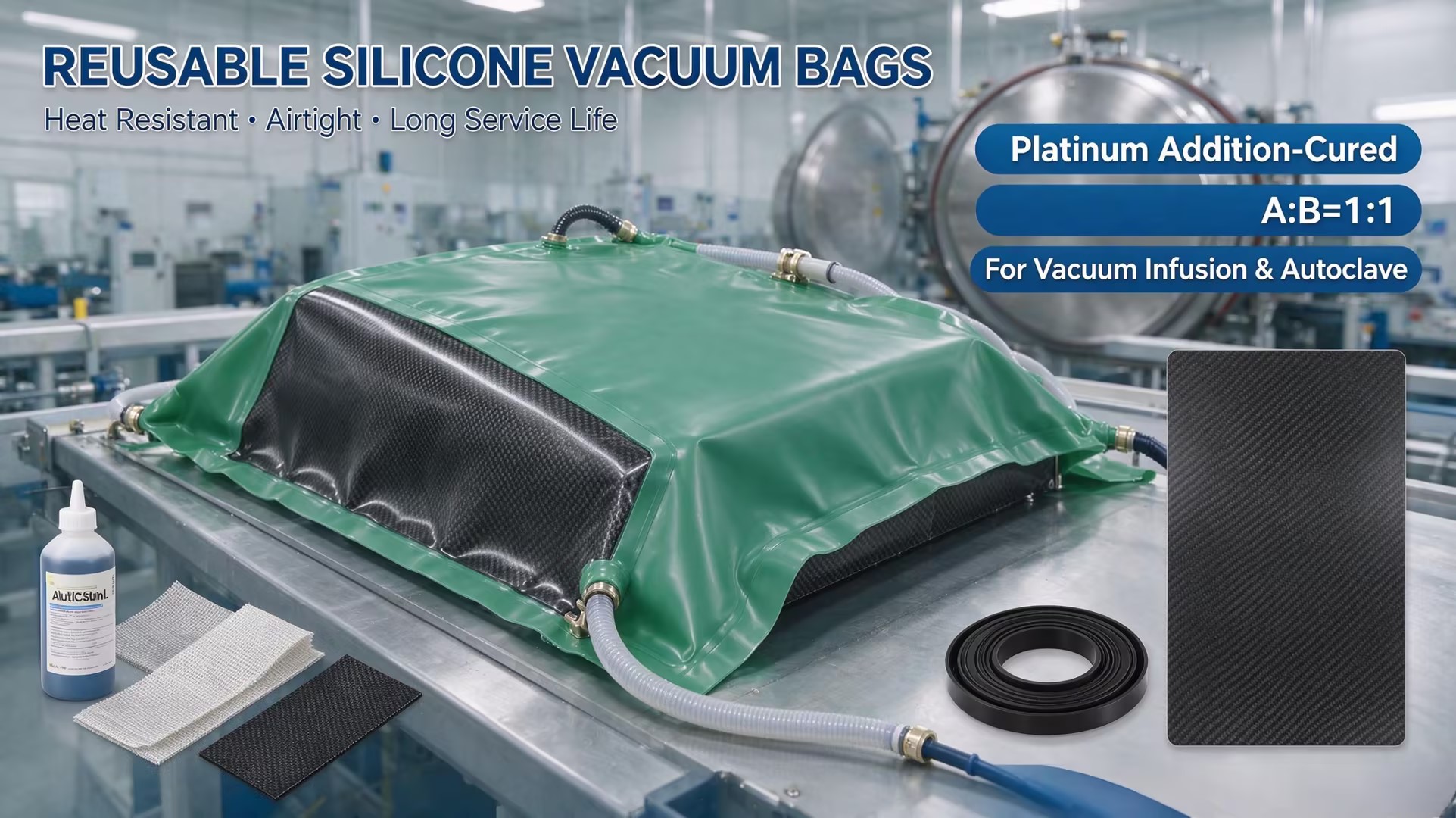
Composite vacuum forming sets three core requirements on silicone: heat resistance, airtightness and resistance to tearing under repeated stretching. Curing temperatures in autoclave processes typically range from 120 to 180℃. Ordinary mold silicone tends to soften, bleed oil and turn sticky under prolonged high temperature, and may even develop micropore leakage, scrapping an entire batch of composite parts. Vacuum bag mold silicone adopts platinum addition-cured system without small molecule volatiles. It withstands composite curing temperatures for long periods, resists softening, oil bleeding and stickiness at high temperature, and maintains stable airtightness through every vacuum cycle.
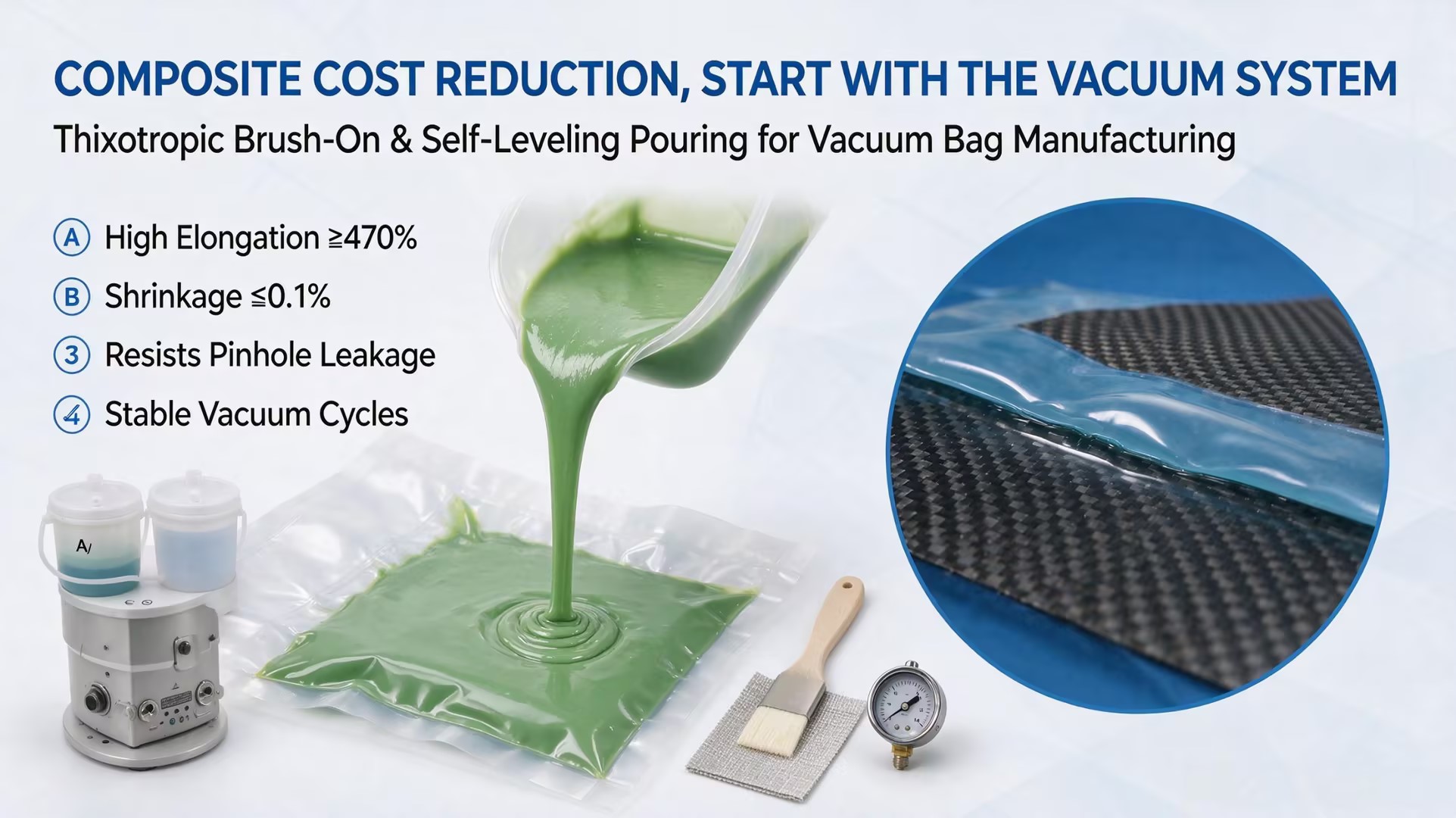
In terms of mechanical performance, vacuum bags repeatedly contract and expand between vacuum and release. Bag edges, flange corners and stiffener positions bear concentrated stress and are high-risk areas for leakage. This vacuum bag silicone has elongation of no less than 470% and high tear strength. After curing, it combines elasticity and toughness. It resists cracking and micropore formation after repeated bending, folding and vacuum cycles, with bag life far exceeding disposable film. Its linear shrinkage is controlled below 0.1%. When making vacuum bags and soft overlay molds, curing shrinkage does not cause surface deviation, ensuring molding precision and uniform wall thickness of composite parts.
For process adaptability, this silicone offers two grades covering different bag-making needs. The thixotropic brush-on grade suits large curved surfaces and complex shaped vacuum bags. It does not sag on vertical surfaces after brushing and allows multi-layer coating with fiberglass cloth reinforcement to improve tear resistance and local strength. The self-leveling pouring grade suits flat surfaces and plate-type components for soft vacuum mold casting. Low viscosity and self-leveling allow rapid coverage of the work surface with fewer bubbles. The product supports room temperature curing and can also cure in 20 to 30 minutes at 60℃, fitting the multi-batch continuous production rhythm of composite factories.
For material compatibility, this product is an addition-cured system that does not react with epoxy or unsaturated polyester resin, and does not contaminate carbon cloth or fiberglass products. Molded composite parts have smooth surfaces without residual contamination. With good chemical inertness, demolding is smooth and the bag can be reused many times. Combined with sealing strips and vacuum lines, a vacuum system can be set up quickly.
Industry trends show the composites sector is moving from extensive production toward refined, low-cost operation. Emerging applications such as wind power, new energy vehicles, hydrogen storage and transport, and low-altitude aircraft continue to raise consistency requirements for composite parts, while factories are more conscious of cost control on auxiliary materials. Once the per-use cost of reusable silicone vacuum bags is amortized, they offer clear economic advantages over disposable film and reduce environmental pressure from waste film disposal. Material suppliers keep optimizing formulas, launching vacuum bag mold silicone grades with different hardness, viscosity and working time, and improving SGS, MSDS and REACH test reports to meet environmental and export compliance requirements of composite factories at home and abroad.

November 10, 2026

November 10, 2026

August 31, 2026

August 25, 2026

November 06, 2026

October 30, 2026
Email to this supplier
November 10, 2026
November 10, 2026
August 31, 2026
August 25, 2026
November 06, 2026
October 30, 2026
Privacy statement: Your privacy is very important to Us. Our company promises not to disclose your personal information to any external company with out your explicit permission.
Fill in more information so that we can get in touch with you faster
Privacy statement: Your privacy is very important to Us. Our company promises not to disclose your personal information to any external company with out your explicit permission.