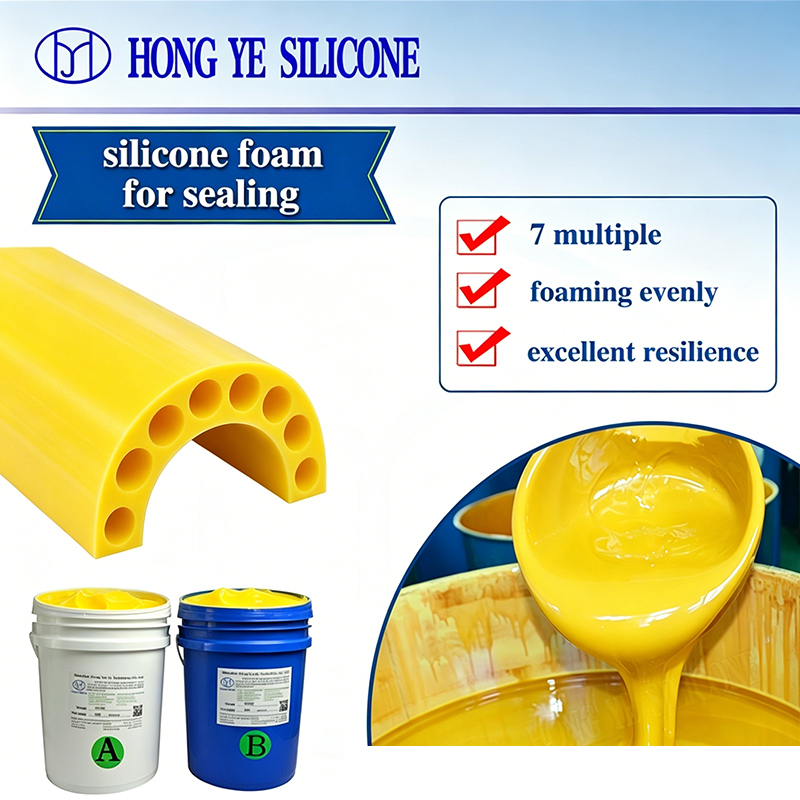


Our liquid silicone foam is two‑part addition‑curing RTV‑2 Foamed Silicone for producing gaskets, sealing strips and soft cushions. Mixable A/B liquid components deliver chemical foaming with 2‑7× adjustable expansion ratio, fine even cell structure and low shrinkage. Working temperature ranges from‑65℃ to 200℃. Non‑toxic and easy‑to‑process, it complements our mold‑making silicone, Pad Printing Silicone and Electronic Potting Compound. Product Overview
Liquid Silicone Foam, also called foamed silicone or Silicone Sponge rubber, belongs to addition‑curing two‑component heat‑vulcanized silicone. Composed of flowable A and B liquids, it generates lightweight soft foam via in‑situ chemical foaming. There is no limitation on finished‑part thickness. Simple operation enables continuous mass‑production. As an eco‑friendly industrial material, it is widely adopted by overseas factories for sealing, shock‑absorbing and filling‑related silicone parts. Key Technical Parameters
Standard mixing ratio is 1:1 for A and B side. The foaming multiple can be adjusted between 2‑7 times original volume. Cured foam features low linear shrinkage and good rebound property. It keeps stable soft performance under long‑term‑65℃~200℃ working environment, offering good insulation, cold‑heat resistance and chemical inertness. No corrosive substances are released after full curing.
Main Product Advantages
Compared with ordinary sponge materials, this foamed silicone achieves homogeneous bubble‑cell distribution without cavity or local dense area. Platinum‑curing system avoids post‑curing migration and shrinkage deformation. Strict batch‑to‑batch quality control keeps performance consistent, just like our mold‑making silicone and potting silicone series. It helps B2B clients cut reject rate and stabilize final‑product quality.
Typical Applications
It is widely applied to fabricate industrial gaskets, sealing pads, sealing strips, foam sheets and sponge rollers. Besides industrial sealing parts, it can produce automotive interior soft components, household cushions, silicone insoles and craft filling layers. Thanks to convenient processing, it shortens molding cycles and reduces raw‑material waste for large‑volume manufacturers.
Operating Guidelines
1. Stir A component and B component separately before mixing to eliminate sediment. 2. Blend A and B at 1:1 ratio and stir evenly for 2‑3 minutes. 3. Apply vacuum de‑airing, then pour or mold right away to prevent early gel which harms foaming effect.
Compliance & Custom Service
This liquid silicone foam meets CE, RoHS and ISO9001 requirements. Customized foaming ratio, hardness and density are available according to customer drawings and application scenarios for automotive, electronics and daily‑use goods industries.
Packaging & Storage Notes
Packing options: 25 kg / 200 kg drums. Treated as non‑dangerous goods in shipment. Store in sealed cool‑dry warehouse. Keep away from UV sunlight, high‑temperature heating, sulfur, phosphorus and heavy‑metal contaminants which will inhibit curing reaction.
FAQ
Q: Why cannot the foamed silicone cure completely? A: Platinum addition‑curing silicone is poison‑sensitive. Contact with sulfur‑containing, tin‑containing or heavy‑metal substances will cause incomplete curing. Please keep tools and working environment clean.
Q: Can I adjust the softness of finished foam? A: Yes, hardness and density can be tuned by formula customization to match your cushion or sealing requirements.