






Send Message
Privacy statement: Your privacy is very important to Us. Our company promises not to disclose your personal information to any external company with out your explicit permission.
 Shenzhen Hong Ye Jie Technology Co., Ltd
English
In recent years, the markets for handmade soap, essential oil soap, cold process soap and cultural gift soap have continued to expand. Pattern soaps, relief art soaps and cartoon shaped soaps, with refined appearance and personalized expression, have become popular categories for handcraft entrepreneurs, cultural brands and gift channels. Unlike high-volume low-price industrial soap, handmade soap's premium comes mainly from shape and detail. Transitions in petal layering, the expression in cartoon shapes and the curve flow of vintage reliefs all directly affect appearance and sales conversion. As the core carrier of soap molding, the mold material's pattern reproduction accuracy, soap base resistance and demolding performance directly determine finished quality and production efficiency. Handmade DIY pattern soap mold silicone rubber enjoys broad application prospects.
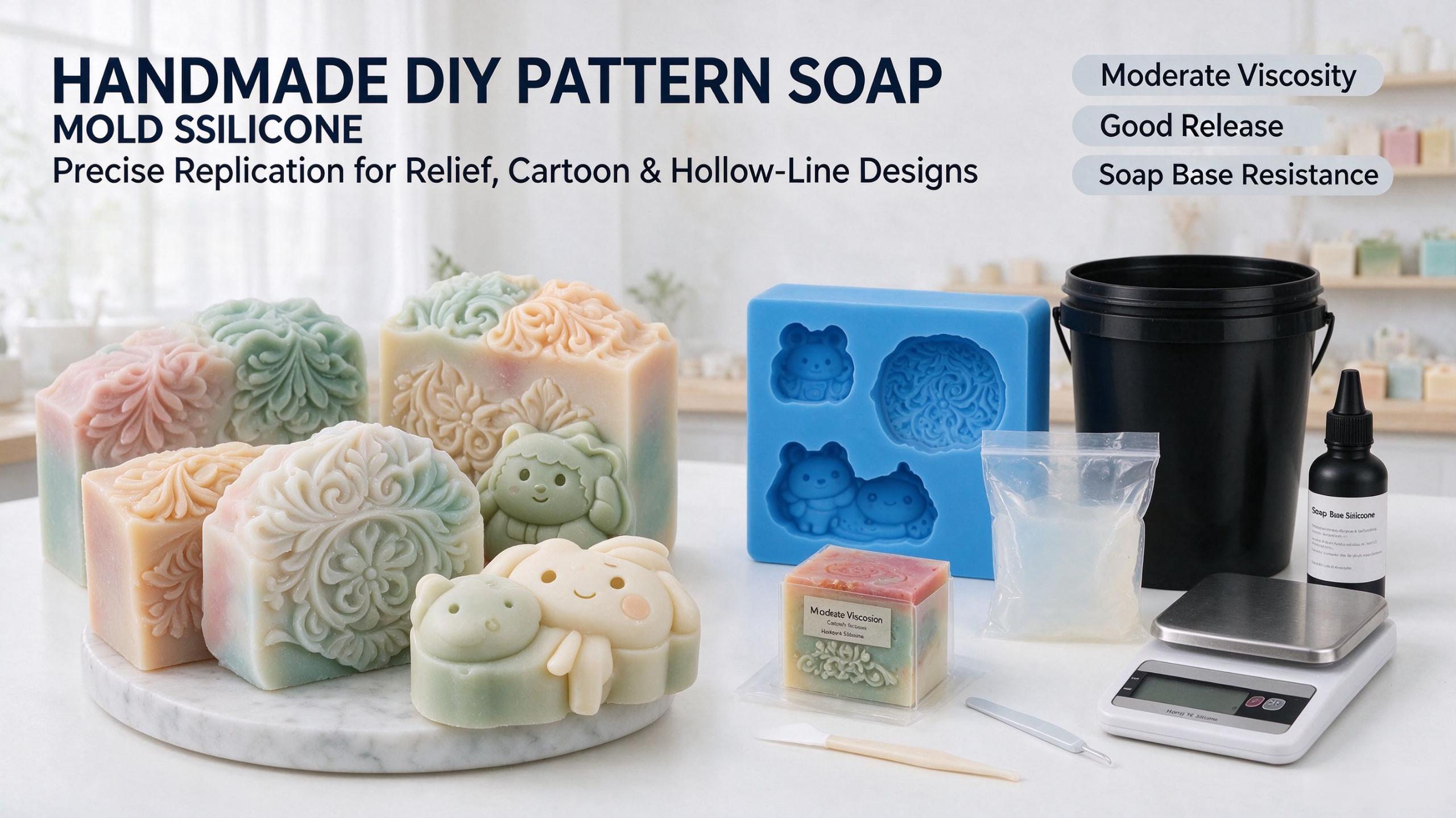
Handmade pattern soap prototypes usually contain fine reliefs, cartoon facial features, hollow lines and tiny patterns, which set relatively high requirements on mold material flowability and wetting ability. Excessive viscosity prevents compound from reaching pattern gaps and sharp corners, causing missing patterns, broken lines and blurred features. Excessively low viscosity causes sagging on vertical surfaces, resulting in locally thin molds that tear during demolding. Handmade DIY pattern soap mold silicone rubber has moderate viscosity and good self-leveling performance. After pouring, it fully conforms to pattern gaps, relief layers and hollow lines, completely reproducing original shapes. Finished soap has clear patterns and clean edges without missing details or bubble pits, restoring design creativity to the maximum.
In terms of soap base resistance, soap production differs markedly from ordinary craft replication. Soap base is alkaline during melting, pouring and cooling, and contains oils and essential oils. Ordinary mold silicone tends to develop sticky surfaces, swelling and powdering under long-term contact, mold life declines rapidly, and finished soap surface finish is affected. This soap-specific casting silicone rubber is optimized for soap base, essential oil soap and alkaline soap liquid systems. In long-term contact it resists stickiness, swelling and surface powdering. The mold resists erosion by soap oils, service life is significantly extended, and mold replacement frequency and mold-making cost are reduced.
In terms of demolding and finished appearance, soap is a soft molded product that is relatively soft and deformable after cooling, so demolding demands high mold elasticity and release performance. This silicone rubber has good elasticity after curing with inherent release effect. Soap releases easily after cooling without additional release agent, avoiding residue that would affect soap surface appearance and user experience. The mold has good resilience and resists tearing in repeated opening and closing. Cartoon shapes, fine patterns and thin edges remain intact during demolding. Finished surfaces are clean, reducing later trimming work.
In terms of structural performance, handmade soap molds are mostly one-piece or multi-piece structures, and parting edges and small protrusions bear concentrated stress when opening, which can cause tearing. The product has tear strength of no less than 18 N/mm and elongation of no less than 400%. Linear shrinkage is controlled within 0.3%, with stable dimensions after curing. Batch-replicated soaps maintain uniform specifications, with consistent size and stable patterns within a series, ensuring neatness of cultural gift box sets.
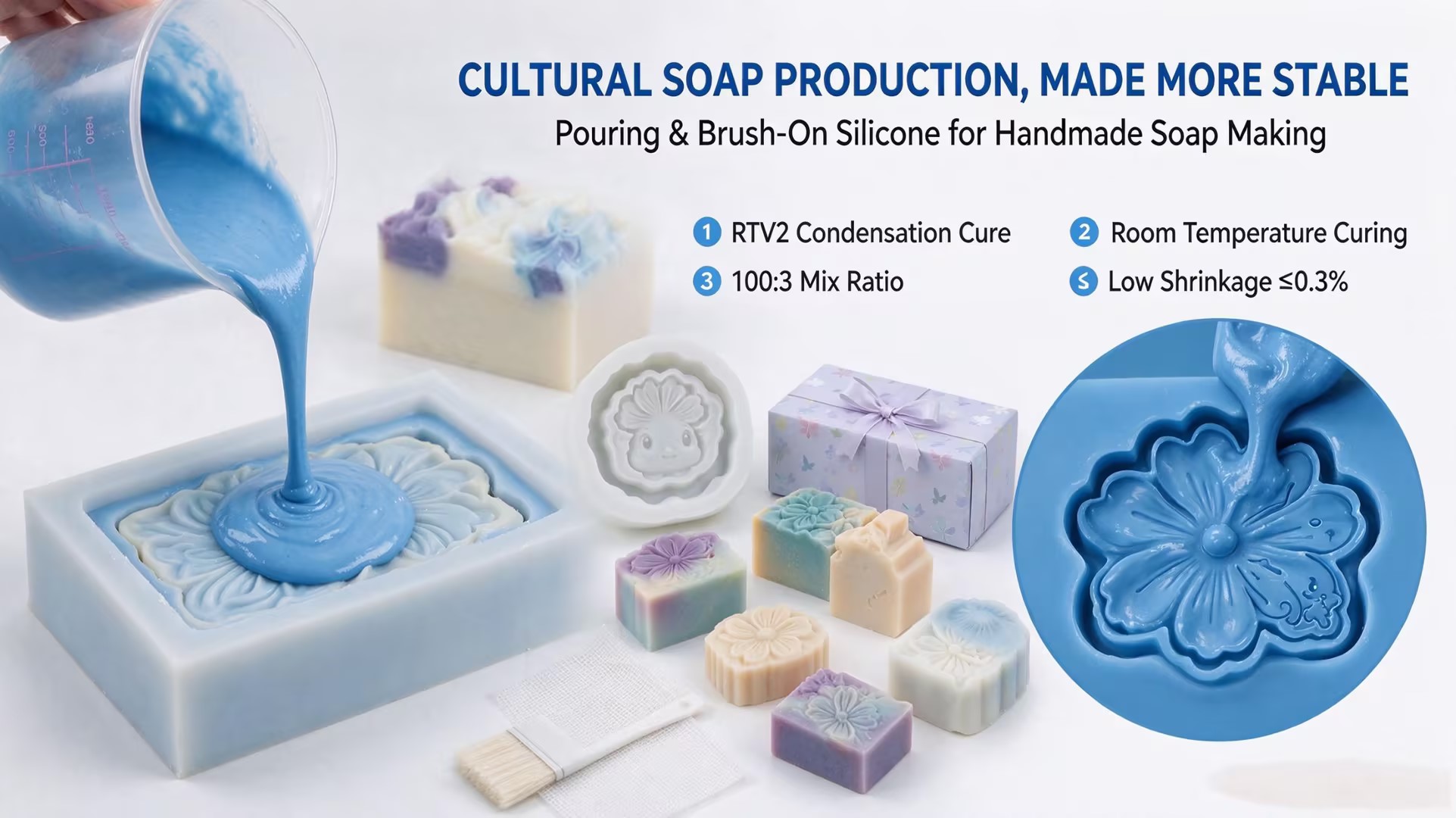
For process adaptability, this liquid silicone supports both pouring and brush-on molding. Regular pattern soaps and cartoon shaped soaps mostly adopt pouring: slowly inject from the low point of the master model so compound rises and expels air to fill the cavity. Complex art soap molds with deep patterns and large areas adopt brush-on molding: apply a thin first layer to ensure pattern gaps are filled, then build thickness with multiple coats, optionally with fiberglass cloth reinforcement for large molds to prevent deformation. The product vulcanizes at room temperature and fully cures in 4 to 6 hours at 25℃ without heating equipment, with a low operating threshold for DIY scenarios, suitable for both workshops and small factories.
In operation, mixing ratio and defoaming directly affect yield. The product is mixed at a weight ratio of Part A to curing agent of 100:3, adjustable to 100:4 in cooler weather. After mixing, vacuum defoaming until bubbles fully rise and break is recommended to avoid small bubbles trapped in pattern gaps. It should be noted that this product is a condensation-cured system and must not contact addition-cured silicone or sulfur, nitrogen and tin containing materials, which would cause incomplete curing and sticky surfaces. After each use, rinse the mold with water and dry it in a cool ventilated place, avoiding direct sunlight, to extend mold life.
Industry trends show the handmade soap and cultural soap market is moving toward small-batch, multi-style and fast-launch flexible production. Holiday limited editions, IP collaboration editions and wedding gift orders keep increasing, and clients often expect design-to-sample verification within one to two weeks. Traditional hard molds have long mold opening cycles and high modification costs, making them difficult to adapt to fast iteration. Room temperature vulcanizing liquid silicone features short mold opening cycles and quick remaking after prototype adjustment, matching this trend. Material suppliers keep optimizing formulas, offering grades with different hardness and working time, and improving SGS and ROHS test reports to meet environmental compliance requirements for cultural soap exports at home and abroad.
Industry insiders state that the final refinement of handmade pattern soap fundamentally depends on mold quality. High-performance handmade DIY pattern soap mold silicone rubber helps designers turn patterns and shapes into mass-replicable soap products stably, lowering the mold-making threshold of complex relief soap. In the future, as the handmade soap and cultural gift market continues to expand, soap mold silicone technology will keep upgrading and continuously empower stable production and efficiency improvement in the handmade soap industry.

November 17, 2026

November 17, 2026

August 31, 2026

August 25, 2026

November 16, 2026

November 13, 2026
Email to this supplier
November 17, 2026
November 17, 2026
August 31, 2026
August 25, 2026
November 16, 2026
November 13, 2026
Privacy statement: Your privacy is very important to Us. Our company promises not to disclose your personal information to any external company with out your explicit permission.
Fill in more information so that we can get in touch with you faster
Privacy statement: Your privacy is very important to Us. Our company promises not to disclose your personal information to any external company with out your explicit permission.