







Send Message
Privacy statement: Your privacy is very important to Us. Our company promises not to disclose your personal information to any external company with out your explicit permission.
 Shenzhen Hong Ye Jie Technology Co., Ltd
English
Behind every great material is a laboratory. The Silicone Foam that cushions a vehicle battery today began as a hypothesis on a researcher's bench years ago; the grade that protects a hospital patient tomorrow is being formulated right now. In the silicone industry, research and development is the engine of everything — turning advances in polymer chemistry into materials that solve problems manufacturers did not even know they had. The story of liquid silicone foam is, at its core, a story of innovation.
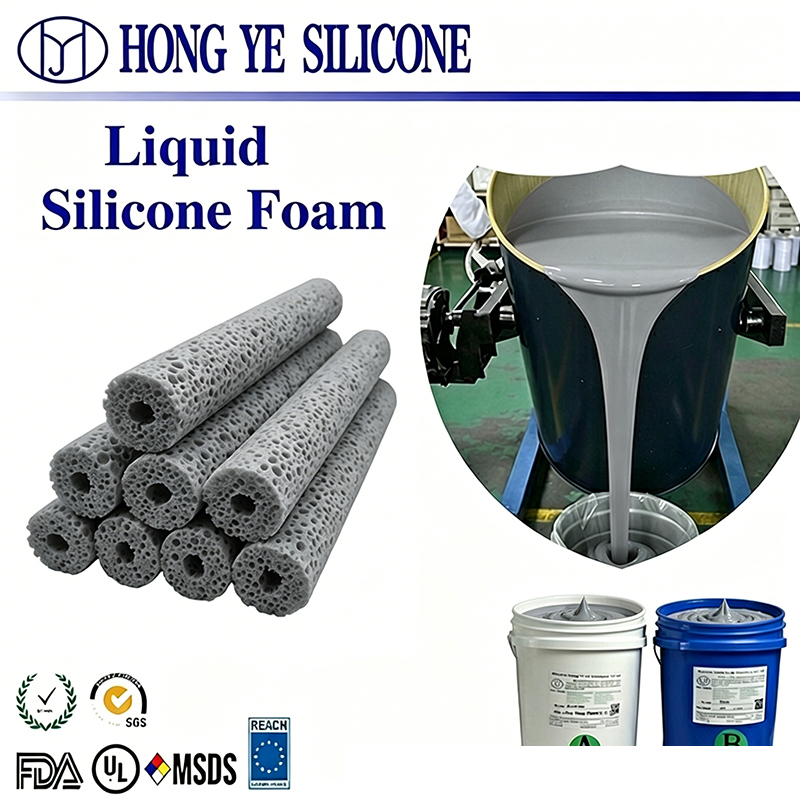
In the early days, silicone foam development was largely empirical. Formulators worked from experience and trial-and-error, adjusting ingredients and hoping for improvement. The results were functional but inconsistent — foams that expanded unpredictably, cells that varied in size, properties that drifted between batches. Without a deep understanding of the chemistry controlling the foaming reaction, progress was slow and replication was difficult. For manufacturers demanding precise, repeatable performance, this uncertainty was a constant frustration.
The mastery of platinum-catalyzed addition-curing chemistry transformed silicone foam from an art into a science. Researchers gained precise control over the foaming reaction — understanding exactly how catalyst chemistry, component ratios, and processing conditions determine cell structure, density, and physical properties. This control unlocked systematic innovation: each new formulation could be designed on paper, tested in the laboratory, and scaled to production with confidence. The platinum cure revolution was not just a chemistry breakthrough — it was the foundation of the modern R&D process that continues to drive the industry forward.
Modern silicone foam development, exemplified by the research programs at Hong Ye Silicone, spans a remarkably broad innovation frontier. R&D teams are engineering foams with precisely tuned hardness and expansion ratios for specific applications, developing flame-retardant formulations for ever-stricter safety codes, and creating food-grade and medical-grade materials that meet rigorous regulatory standards. They are exploring thermally conductive foam grades for battery thermal management, ultra-low-density formulations for aerospace, and specialized versions for acoustic, electronics, and consumer applications. Each innovation is validated through systematic testing — viscosity, expansion ratio, hardness, rebound, temperature resistance — ensuring that laboratory breakthroughs become reliable production materials.

The innovation pipeline continuously feeds new applications. As R&D delivers new grades, engineers discover new uses: a softer formulation enables a premium insole; a flame-retardant grade opens the door to battery protection; a medical-grade material enables patient care products; a low-viscosity version automates a production line. The expansion of silicone foam into new industries — from electric vehicles to healthcare, from consumer goods to construction — is driven directly by this steady stream of innovation, each new capability unlocking the next market.
Innovation in the laboratory must translate into consistent production. Modern manufacturing facilities, like those operated by Hong Ye Silicone, close the gap between R&D and production: automated lines replicate laboratory conditions at scale, while ISO9001-certified quality systems ensure that what works in development works identically on the production floor. This integration of research and manufacturing — with laboratory testing at every stage and final inspection before shipment — is what transforms innovative formulations into dependable industrial products.
The innovation pipeline points toward a future of genuinely smart materials. Self-healing foam formulations that repair minor damage, sensor-integrated foams that monitor pressure and temperature, and recyclable bio-based systems for the circular economy represent the most ambitious research directions. Multi-functional foams that combine cushioning with thermal management, acoustic performance, and electromagnetic shielding are already on the horizon. As these technologies mature, they will redefine what silicone foam can do — and open applications that do not yet exist.

The evolution of liquid silicone foam is a testament to the power of persistent innovation. From empirical beginnings to precise, engineered formulations, the material has been transformed by decades of research — and the pace of change is only accelerating. Companies like Hong Ye Silicone, with dedicated R&D teams, decades of accumulated expertise, and continuous investment in both laboratory and production technology, stand at the forefront of this pipeline, bringing the next generation of silicone foam materials from the laboratory to the world.

September 18, 2026

September 18, 2026

August 31, 2026

August 25, 2026

September 14, 2026
Email to this supplier
September 18, 2026
September 18, 2026
August 31, 2026
August 25, 2026
September 14, 2026
Privacy statement: Your privacy is very important to Us. Our company promises not to disclose your personal information to any external company with out your explicit permission.
Fill in more information so that we can get in touch with you faster
Privacy statement: Your privacy is very important to Us. Our company promises not to disclose your personal information to any external company with out your explicit permission.