







Send Message
Privacy statement: Your privacy is very important to Us. Our company promises not to disclose your personal information to any external company with out your explicit permission.
 Shenzhen Hong Ye Jie Technology Co., Ltd
English
Drones have moved from hobby to essential infrastructure — inspecting power lines, delivering medical supplies, mapping farms, filming productions, and surveying disaster zones. These aircraft fly where people cannot, in conditions that punish technology: constant vibration, temperature extremes, hard landings, and the inevitable crash. Every drone is a collection of delicate electronics kept airborne by precision engineering — and protected by materials that absorb the punishment of flight. In this demanding world, liquid silicone foam has become a critical partner, protecting the sensors, cameras, and batteries that keep drones in the air.
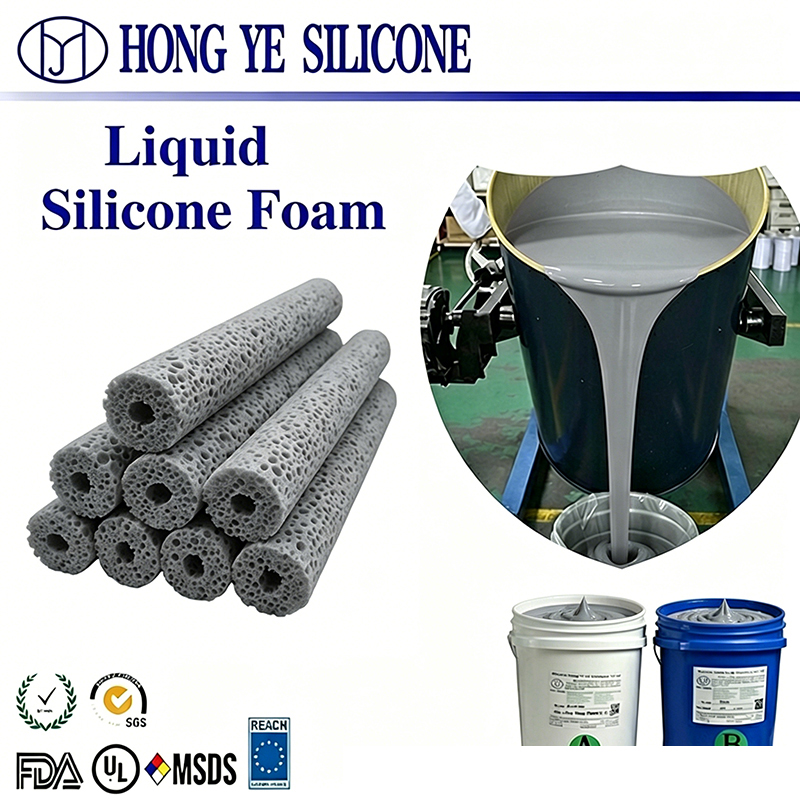
In the early days of drone development, builders faced a persistent materials challenge. The vibration of motors and rotors degraded image quality, disturbed sensors, and loosened components. Cameras and gimbals — the most sensitive parts of any drone — were especially vulnerable to the constant shaking of flight. Batteries, the heart of every mission, required protection from impact and thermal stress. Conventional foams absorbed moisture, degraded in heat, and failed after repeated hard landings. For drone manufacturers, the materials protecting their electronics were often the weak point in the entire system.
The adoption of platinum-catalyzed addition-curing Silicone Foam gave drone engineers a material engineered for flight. Platinum-cured foam provides reliable vibration damping that isolates cameras and sensors from motor vibration, delivering the stable, clear imagery that modern drones are known for. Its wide temperature range protects electronics from the heat of motors and the cold of high-altitude flight. Its excellent rebound resilience absorbs impact after impact, protecting delicate components through hard landings and minor crashes. And its moisture resistance protects drones during flights in rain, humidity, and marine environments.
Modern liquid silicone foam grades, such as those produced by Hong Ye Silicone, are engineered for the specific demands of UAV technology. The material's excellent vibration-damping properties isolate sensitive cameras, gimbals, and sensors, ensuring stable footage and accurate data. The wide service temperature range of -65°C to 200°C protects electronics through every phase of flight, from ground heat to high-altitude cold. Its impact absorption protects batteries and components during hard landings, while the lightweight structure adds minimal weight to aircraft with strict payload budgets. Its moisture resistance enables operation in wet conditions, and its durability means protection that survives the rough handling that drones endure.

Silicone foam now serves the drone industry across the full range of applications. In consumer and commercial drones, it isolates camera gimbals, cushions batteries, and protects flight controllers from vibration. In industrial inspection drones, it protects sensitive sensors and imaging equipment through demanding missions. In delivery and logistics drones, it cushions payloads and protects electronics through frequent landings. In agricultural drones, it seals and protects systems exposed to dust, chemicals, and field conditions. In military and defense UAVs, it protects classified electronics through the most demanding operational environments. In drone ground equipment, it cushions controllers, chargers, and transport cases. In each application, silicone foam helps keep drones flying and their precious electronics intact.
Drone components demand precision and consistency. Modern manufacturing facilities, like those operated by Hong Ye Silicone, combine automated production lines with rigorous quality systems: raw material inspection, controlled processing, laboratory testing of every batch, and final inspection before shipment. ISO9001-certified quality management and tight dimensional control give drone manufacturers the reliability they require — where a single failed component can mean a lost aircraft.
The future of UAV technology points toward greater autonomy and capability. Ultra-light foam grades for extended flight endurance, thermally conductive materials for advanced battery systems, and sensor-integrated protection for autonomous flight represent the most promising research directions. As drones take on more missions — from urban air mobility to beyond-visual-line-of-sight operations — the role of advanced silicone foam will continue to grow.


Every drone in the sky is a triumph of engineering — and every safe landing is a testament to the materials that protect it. Liquid silicone foam is one of those essential materials, damping the vibration that degrades performance, absorbing the impacts that threaten components, and protecting the electronics that keep drones flying. Companies like Hong Ye Silicone, with decades of formulation expertise and advanced production capability, are helping drone manufacturers around the world build aircraft that fly higher, see clearer, and land safer — above the rest.

August 31, 2026

August 25, 2026

November 13, 2026

November 11, 2026
Email to this supplier
August 31, 2026
August 25, 2026
November 13, 2026
November 11, 2026
Privacy statement: Your privacy is very important to Us. Our company promises not to disclose your personal information to any external company with out your explicit permission.
Fill in more information so that we can get in touch with you faster
Privacy statement: Your privacy is very important to Us. Our company promises not to disclose your personal information to any external company with out your explicit permission.