






Send Message
Privacy statement: Your privacy is very important to Us. Our company promises not to disclose your personal information to any external company with out your explicit permission.
 Shenzhen Hong Ye Jie Technology Co., Ltd
English
In recent years, European exterior decoration styles have continued to return, and demand for villa facade renovation, garden landscape gypsum components and commercial building facade carvings has recovered steadily. Exterior carvings, gypsum roman columns, decorative moldings and relief panels, with their three-dimensional layering and light-shadow texture, have become important elements enhancing building facade recognizability. Unlike interior decorative pieces, exterior components are large in size, deep in pattern and strict in installation tolerance. A single building often requires dozens to hundreds of carved components with identical specifications, and any dimensional deviation or missing pattern becomes immediately visible on site. As the core carrier of carving molding, the mold material's detail reproduction accuracy, gypsum resistance and dimensional stability directly determine project delivery quality and production cost. Exterior carved gypsum mold silicone enjoys broad application prospects.
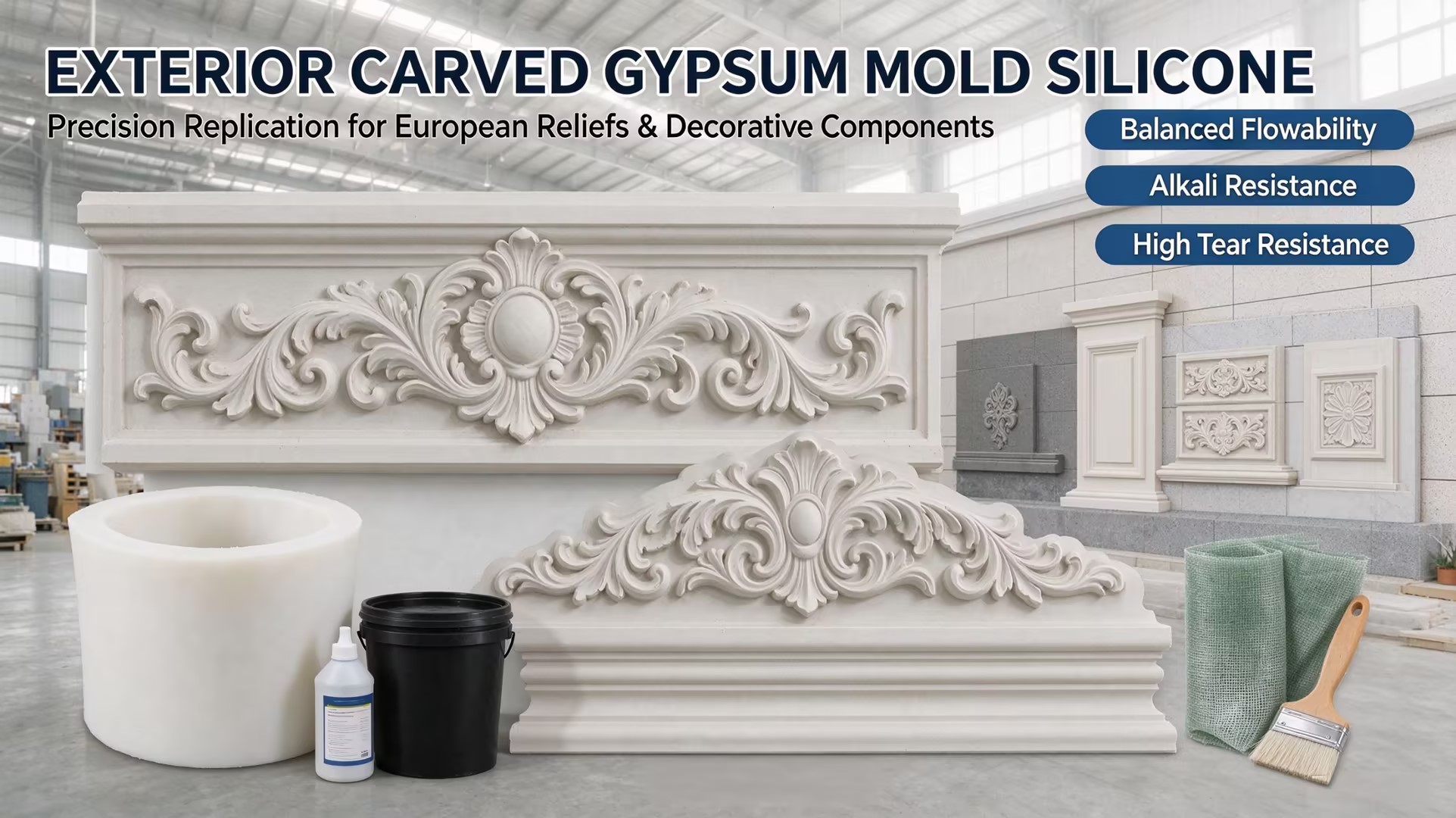
Exterior carving prototypes usually contain interleaved deep and shallow relief patterns, scrolled floral motifs and European carved edges with deep grooves and multiple layers, placing two-way demands on mold material flowability. Excessively high flowability causes sagging on vertical surfaces, leaving local thin areas and tearing during demolding. Excessively low flowability fails to fill groove bottoms and sharp floral corners, causing missing patterns and broken lines. Exterior carved gypsum mold silicone keeps viscosity within a moderate range, and consistency can be adjusted for different processes. It does not sag during brush-on molding, while self-leveling fills pattern cavities during pouring. It fully reproduces deep relief patterns, scrolled floral motifs and European carved edges. Finished components have clear patterns and distinct layering without missing details or bubble defects.
In terms of gypsum resistance, exterior gypsum component production involves long-term contact with gypsum slurry. The gypsum hydration process is alkaline and involves slight expansion and surface powdering during curing. Ordinary mold silicone tends to develop sticky surfaces, dullness and powder sticking during long-term repeated casting, and mold life declines rapidly, affecting component surface finish. This exterior-specific mold silicone is optimized for alkaline gypsum slurry systems. In repeated casting it resists stickiness, powdering and surface dulling. Demolding is smooth, mold service life is long, and mold replacement frequency and mold-making cost are reduced.
In terms of mechanical and dimensional performance, exterior carved components often carry concave-convex undercuts, deep grooves and sharp edges, with concentrated stress during demolding, which strongly tests tear resistance. This silicone rubber has tear strength of no less than 20 N/mm and elongation of no less than 450%. It combines good elasticity and resilience after curing. Carved molds with undercut structures resist tearing and chipping during demolding, and retain original contours after many cycles. Linear shrinkage is controlled within 0.3%, and dimensions remain stable after curing. Mass-produced exterior gypsum components maintain uniform specifications, meeting installation tolerances on site and reducing on-site trimming and rework.
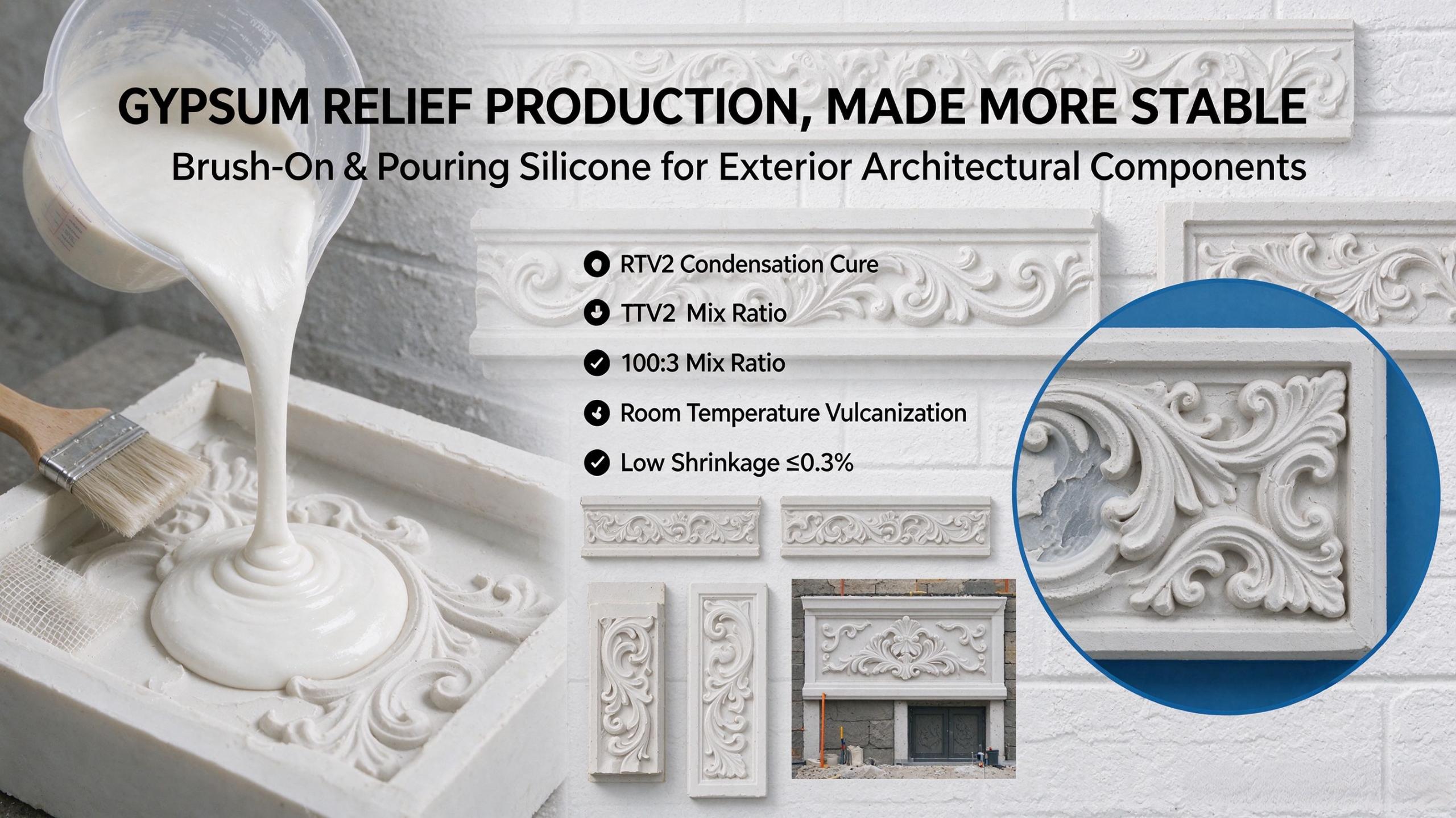
For process adaptability, this liquid silicone supports both brush molding and pouring. Large-area exterior reliefs, extra-long decorative moldings and complex relief panels mostly adopt brush molding: apply a thin first layer to ensure patterns are completely filled, then lay fiberglass cloth reinforcement, repeat coating two to three times to a total thickness of 3 to 5 mm, and build an outer support backing to prevent mold deformation. Components with relatively regular shapes can be poured directly, slowly injecting from the low point so compound rises naturally and releases bubbles, avoiding direct impingement on the master model. The product vulcanizes naturally at 25℃ without oven equipment, whether for factory batch production or on-site mold making near the construction site.
In operation, mixing ratio and defoaming are key to yield. The product is mixed at a weight ratio of Part A to curing agent of 100:3. In cooler weather it can be raised to 100:4, and in hot weather curing agent is reduced to extend working time. After mixing, vacuum defoaming is recommended until no large bubbles emerge, avoiding pinhole defects in deep carved grooves. It should also be noted that this product is a condensation-cured system and must not contact addition-cured silicone or sulfur, nitrogen and tin containing materials, which would cause curing inhibition and sticky surfaces. New molds are recommended to cast one or two test gypsum parts before batch production.
Industry trends show the building decoration sector is moving from on-site hand carving toward factory prefabrication and standardized installation. Whole-house renovation companies and engineering channels keep raising requirements on batch supply capacity and dimensional consistency of exterior carved components. The same style often requires long-term repeated replication, and mold durability directly determines the amortized mold cost per component. Meanwhile, cultural tourism projects, European villas and antique-style blocks bring more customized styles, requiring short mold opening cycles and flexible modification. Liquid silicone features short mold opening cycles and quick remaking after prototype adjustment, aligning with this trend. Material suppliers keep optimizing formulas, offering grades with different hardness and working time, and improving test reports to meet environmental and compliance requirements of construction projects at home and abroad.
Industry insiders state that the final effect of exterior carved components fundamentally depends on mold quality. High-performance exterior carved gypsum mold silicone helps convert European reliefs from design drawings into mass-producible gypsum components with consistent dimensions, lowering the mold-making threshold for complex carvings. In the future, as European exterior decoration and urban renewal projects continue to advance, exterior carved gypsum mold silicone technology will keep upgrading and continuously empower stable production and cost reduction in the building decoration industry.

November 16, 2026

November 16, 2026

August 31, 2026

August 25, 2026

November 16, 2026

November 13, 2026
Email to this supplier
November 16, 2026
November 16, 2026
August 31, 2026
August 25, 2026
November 16, 2026
November 13, 2026
Privacy statement: Your privacy is very important to Us. Our company promises not to disclose your personal information to any external company with out your explicit permission.
Fill in more information so that we can get in touch with you faster
Privacy statement: Your privacy is very important to Us. Our company promises not to disclose your personal information to any external company with out your explicit permission.