







Send Message
Privacy statement: Your privacy is very important to Us. Our company promises not to disclose your personal information to any external company with out your explicit permission.
 Shenzhen Hong Ye Jie Technology Co., Ltd
English
In recent years, niche design jewelry, DIY handmade accessories and cultural ornament markets have expanded steadily. Resin epoxy pendants, vintage relief earrings, imitation jade bracelets and filigree hollow accessories, with personalized shapes and relatively low production barriers, have become popular directions for handcraft entrepreneurs and independent designers. Unlike large artworks, jewelry products are small in size with dense details. The fineness of patterns and shapes directly determines recognizability and price premium. Petal layering on a relief earring or line flow on a hollow pendant loses refinement once any detail is blurred or missing. As the core carrier of jewelry replication, the mold material's detail reproduction accuracy and demolding performance directly determine finished quality. Jewelry artwork liquid casting silicone enjoys broad application prospects.
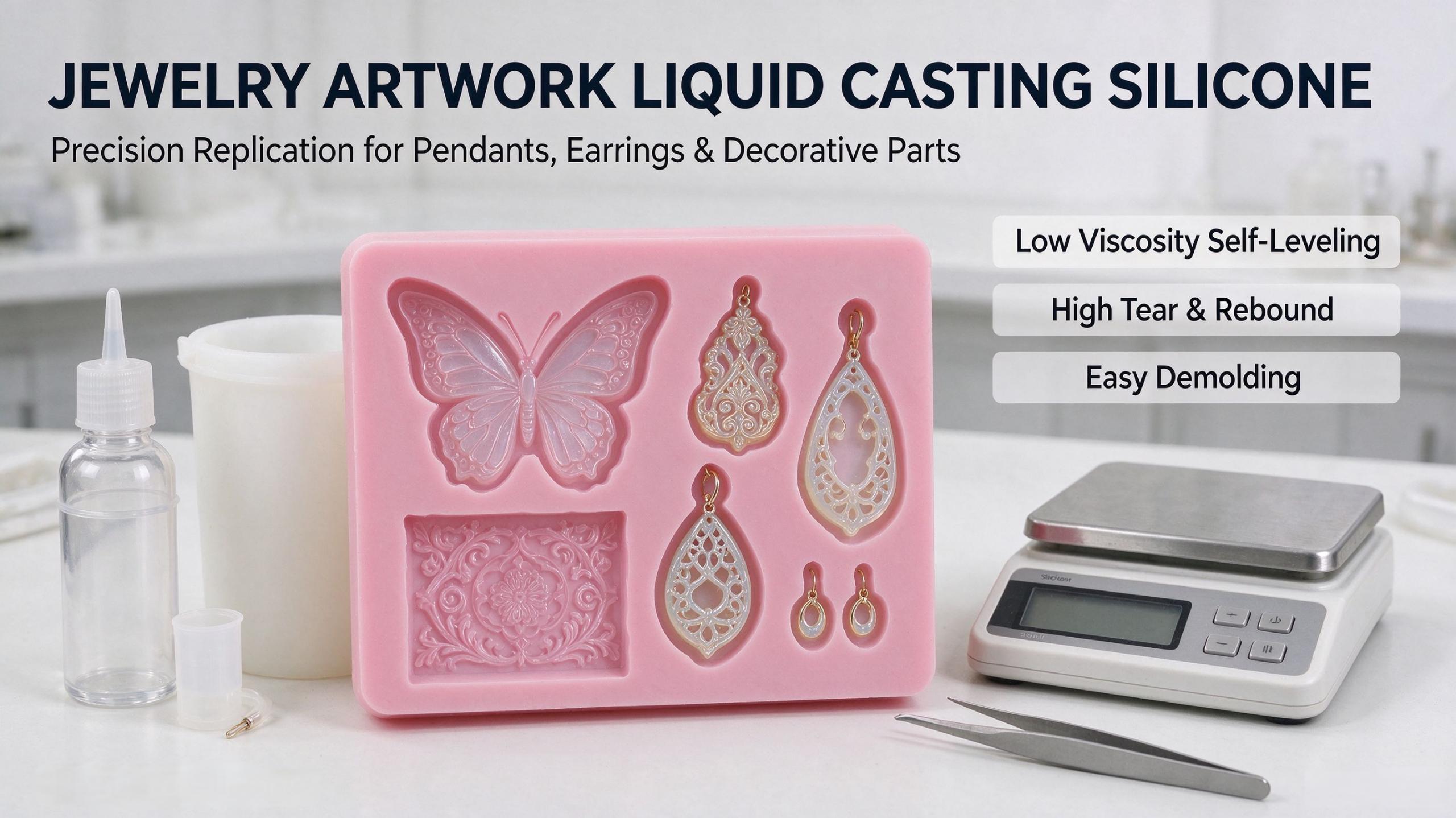
Jewelry prototypes are usually very small but contain numerous fine shapes, including relief patterns, micro-carved textures, filigree hollows and setting grooves. These details set extremely high requirements on the flowability and wetting ability of mold materials. Excessive viscosity prevents compound from entering narrow gaps, causing missing patterns and broken lines. Excessively low viscosity causes sagging on vertical surfaces and uneven local thickness. Jewelry liquid casting silicone keeps viscosity within 2,000 to 4,000 cps with excellent self-leveling performance. After casting, it fully penetrates relief patterns, micro-carved details and hollow gaps, precisely restoring original shapes. Finished jewelry has clear patterns and sharp edges without missing patterns or bubble pits, restoring design creativity to the maximum.
In terms of demolding and durability, jewelry molds typically have walls only a few millimeters thick and are opened and closed frequently with concentrated local stress, which seriously tests silicone toughness and tear resistance. Traditional mold materials tend to tear or break at small protrusions and hollow lines, causing mold scrap. This jewelry-specific casting silicone delivers high tear resistance and resilience after curing. Molds resist tearing and deformation in repeated opening and closing, and fine structural positions resist damage during demolding. Its cured surface has inherent release effect, so resin, wax, gypsum and low-temperature alloy castings release easily without sticking, reducing reliance on release agents and avoiding residual contamination on jewelry surfaces.
In terms of dimensional accuracy, jewelry requires high consistency in finished dimensions. Pendant size and setting dimensions within the same series must stay uniform to ensure subsequent assembly and batch shipment. The addition-cured series controls linear shrinkage below 0.1%, while the condensation-cured series stays within 0.3% to 0.5%. Dimension remains stable after curing. Batch-replicated accessories maintain uniform specifications, reducing later repair and rework while ensuring quality consistency within a series.
For system selection, the product offers addition-cured and condensation-cured series to cover different needs. The platinum addition-cured series releases no small molecules and does not contaminate silver or epoxy products. It is available in highly transparent grades, allowing direct observation of internal casting status during replication for jewelry quality inspection. It suits high-end precision jewelry and clear parts. The condensation-cured series is more cost-effective and suits batch production of resin epoxy jewelry and gypsum accessories. Hardness options from 10 to 30 Shore A are available. Fine micro-carved parts can use lower hardness for better demolding resilience, while larger structures requiring rigidity can use slightly higher hardness.
For process, this liquid silicone supports both pouring and multi-piece brush molding. Small regular jewelry gives priority to pouring, slowly casting from the low point of the model and filling pattern cavities by self-leveling. Complex multi-surface jewelry and deep undercut shapes adopt multi-piece brush molding: apply a thin first layer to cover patterns, then build thickness layer by layer with planned parting lines. The product cures at room temperature and can also cure in 30 to 60 minutes at 60℃, fitting small-batch prototyping in handcraft studios and multi-batch continuous production in jewelry factories.
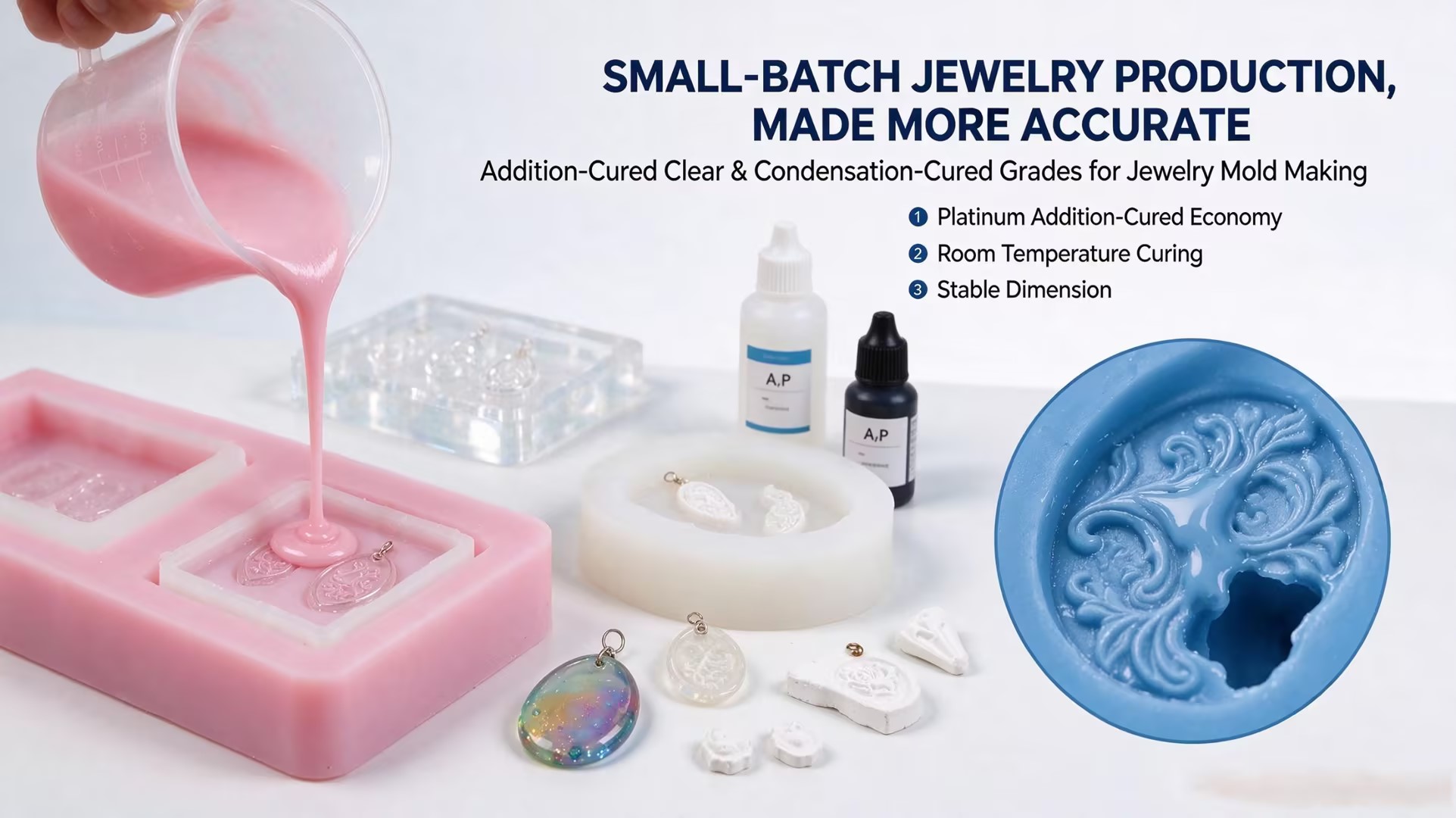
Industry trends show the jewelry sector is moving toward small-batch, multi-style and fast-launch flexible production. Custom orders from independent designer brands, handcraft markets and social commerce keep rising, and clients often expect prototype-to-sample verification within a week. Traditional hard molds have long mold opening cycles and high modification costs, making them difficult to adapt to fast iteration. Liquid silicone features short mold opening cycles. After prototype adjustment, the mold can be remade quickly, perfectly matching the fast new product launch and custom order receiving trend in the jewelry industry. Material suppliers keep optimizing formulas, launching jewelry casting silicone grades with different hardness, viscosity and working time, and improving SGS, MSDS and REACH test reports to meet environmental compliance requirements for jewelry exports at home and abroad.
Industry insiders state that the final refinement of jewelry artworks fundamentally depends on mold quality. High-performance jewelry artwork liquid casting silicone helps designers turn fine originals into mass-replicable resin, wax and gypsum accessories stably, lowering the technical threshold of micro-carved jewelry replication. In the future, as the personalized jewelry and cultural ornament market continues to expand, jewelry casting silicone technology will keep upgrading and continuously empower innovation in jewelry design and handcraft industries.

August 31, 2026

August 25, 2026

November 11, 2026

November 06, 2026
Email to this supplier
August 31, 2026
August 25, 2026
November 11, 2026
November 06, 2026
Privacy statement: Your privacy is very important to Us. Our company promises not to disclose your personal information to any external company with out your explicit permission.
Fill in more information so that we can get in touch with you faster
Privacy statement: Your privacy is very important to Us. Our company promises not to disclose your personal information to any external company with out your explicit permission.