







Send Message
Privacy statement: Your privacy is very important to Us. Our company promises not to disclose your personal information to any external company with out your explicit permission.
 Shenzhen Hong Ye Jie Technology Co., Ltd
English
In recent years, niche markets for realistic portrait sculptures, cultural portrait ornaments, museum replica figures and film character props have grown steadily. Collectors and consumers have raised higher requirements on facial realism, skin texture details and product consistency. Unlike ordinary decorative pieces, portrait artworks depend heavily on facial features, skin texture, hair direction and drapery folds, which directly affect recognizability and artistic impact. Any lost or distorted detail will strip the work of its spirit. As the core carrier of portrait replication, the mold material's detail restoration accuracy and flexibility directly determine final quality. Portrait artwork replication silicone rubber enjoys broad application prospects.
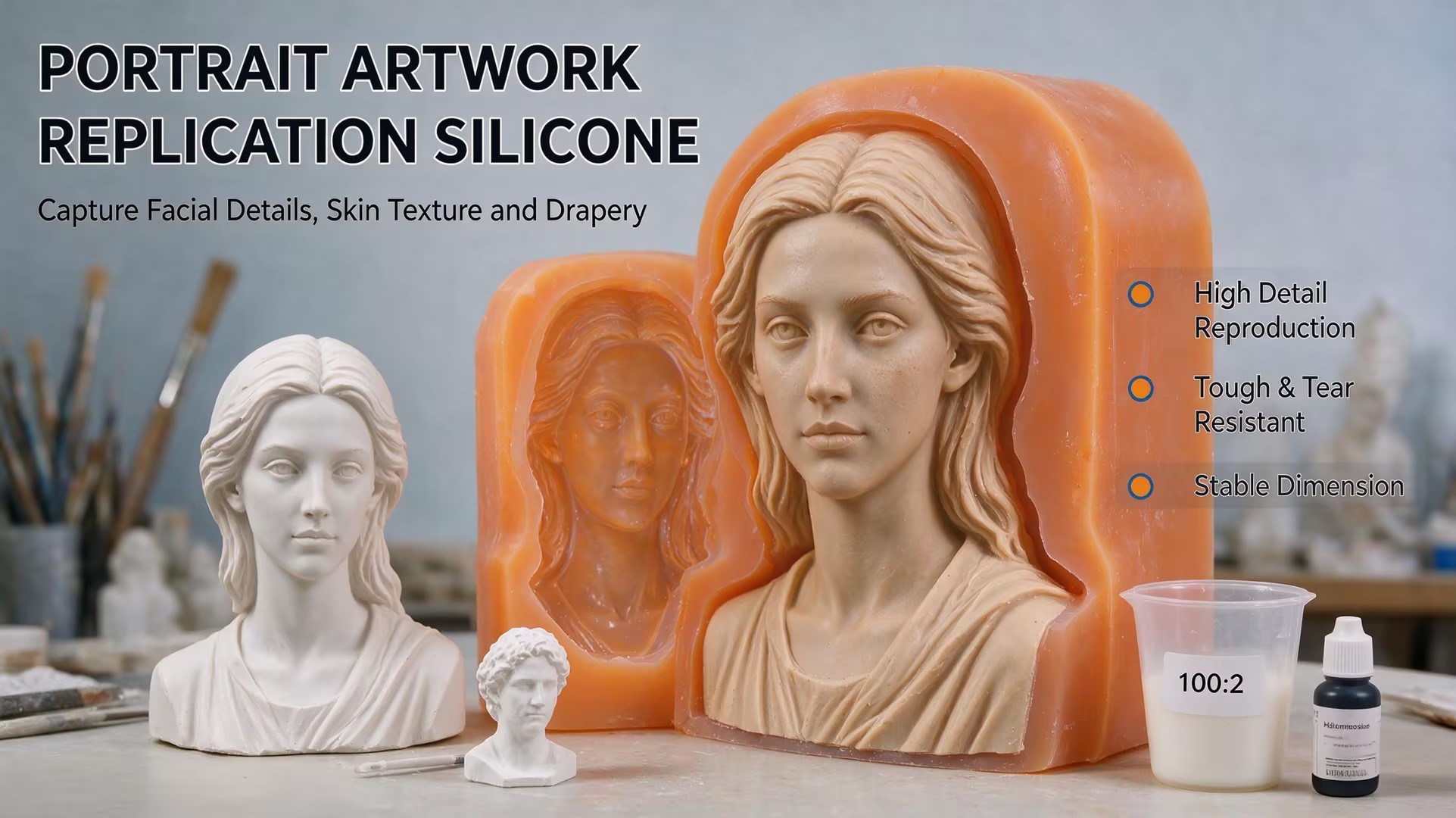
Portrait sculpture prototypes carry numerous fine shapes, including nose wing grooves, eyelid folds, lip lines, pore texture, hair layering and drapery undulation, which set extremely high standards for mold material reproduction. Traditional mold materials tend to blur facial details, miss edges or damage surfaces during demolding. Portrait artwork replication silicone rubber offers excellent fluidity. Thixotropic grades stay attached to vertical surfaces without sagging after brushing, fully conforming to every rise and fall of the prototype. It captures facial contours, skin texture, wrinkles, drapery and eyelash strands completely. Replicas show natural expression and clear details, restoring the sculptor's original creation to the maximum.
In terms of process adaptability, portrait replication differs entirely from flat components. Full-body or bust figures have complex curved surfaces and many undercuts, requiring multi-piece mold structures for successful demolding. This silicone rubber offers thixotropic brush-on and low-viscosity pouring systems. Large figures and complex curved figures give priority to brush-on molding: apply a thin first layer from bottom to top, focusing on facial features, then after surface drying apply multiple coats with fiberglass cloth reinforcement, and finally build a gypsum or FRP outer shell. Small figures and closed-loop molds adopt low-viscosity pouring, slowly filling from the low point and filling the cavity by self-leveling. Both systems operate at room temperature in sculpture studios without heating equipment.
In terms of mechanical performance, the parting edges, ears, fingers and garment corners of portrait molds are vulnerable areas. Repeated pulling during demolding seriously tests silicone toughness and tear resistance. This portrait-specific silicone rubber is soft yet tough after curing with high tear strength. It resists tearing at parting edges during demolding, and thin edges and small protrusions do not chip easily. The mold supports many replication cycles with long service life. Its linear shrinkage rate is controlled below 0.3%. After curing, dimension remains stable. Mass-replicated portrait works keep uniform size and stable facial proportions, ensuring artistic consistency within a series.
For material compatibility, this silicone rubber does not react adversely with gypsum, unsaturated resin, epoxy resin, PU or wax. Demolding is smooth without adhesion, and molded parts have smooth surfaces, reducing later grinding and repair work. The formula can be adjusted for hardness, viscosity and working time. A 25A hardness is mainstream for portraits, balancing detail reproduction and demolding flexibility. Fine small pieces can use lower hardness, while large multi-piece molds can use slightly higher hardness for better rigidity.
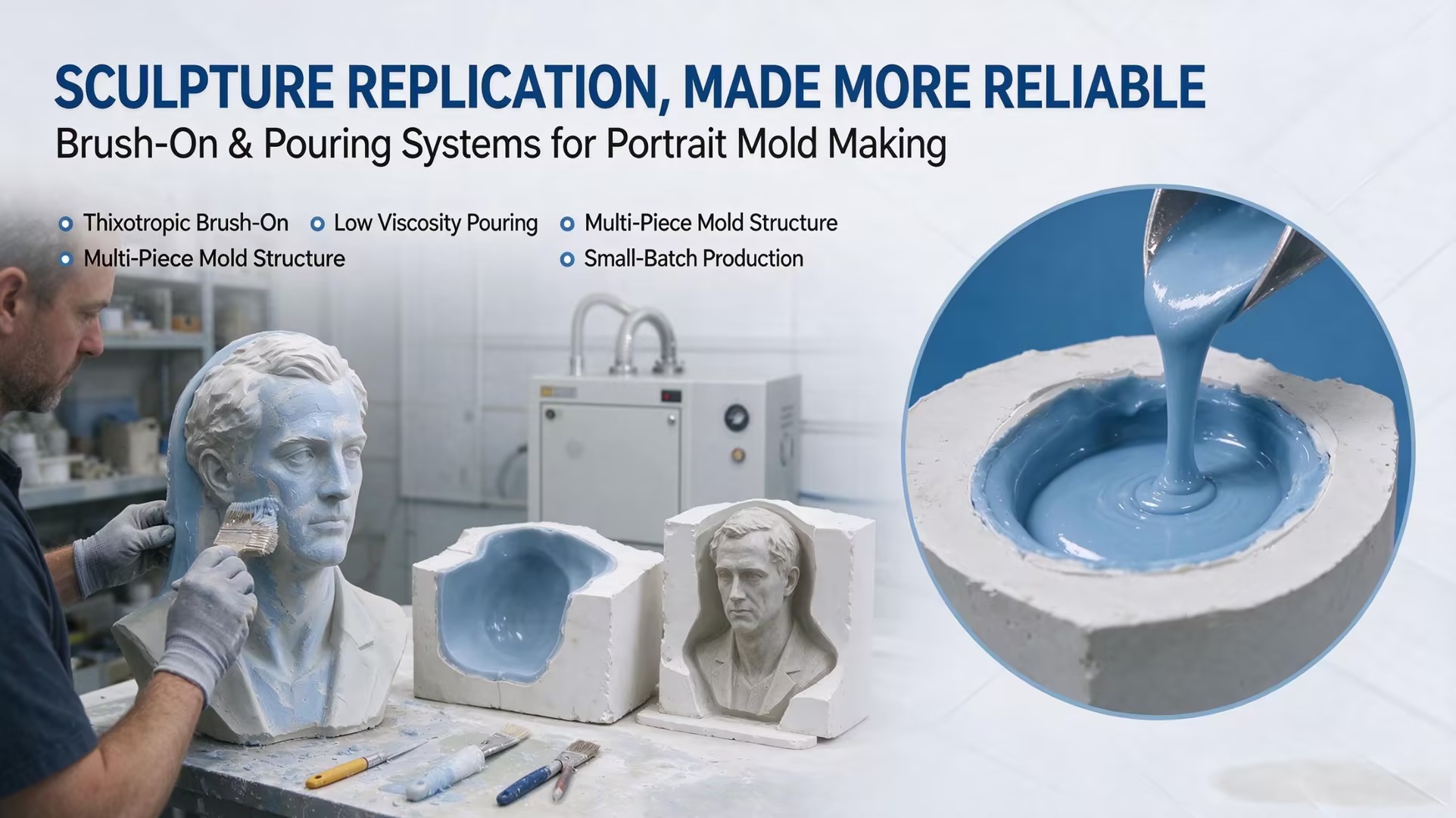
Industry trends show the cultural portrait and art replication market is moving toward small-batch, multi-style and customized flexible production. Orders for custom portrait ornaments, IP character figures and film prop replicas keep rising, and clients often need verification from prototype to sample within one to two weeks. Traditional hard molds have long mold opening cycles and high modification costs, making them difficult to adapt to fast iteration. Room temperature vulcanizing liquid silicone features short mold opening cycles. After prototype modification, the mold can be remade quickly, perfectly matching the fast new product launch and custom order receiving trend in the cultural industry. Material suppliers keep optimizing formulas, launching portrait replication silicone grades with different hardness, viscosity and working time, and improving test reports to meet environmental compliance requirements for domestic and overseas craft exports.

November 09, 2026

August 31, 2026

August 25, 2026

November 06, 2026

October 30, 2026
Email to this supplier
November 09, 2026
August 31, 2026
August 25, 2026
November 06, 2026
October 30, 2026
Privacy statement: Your privacy is very important to Us. Our company promises not to disclose your personal information to any external company with out your explicit permission.
Fill in more information so that we can get in touch with you faster
Privacy statement: Your privacy is very important to Us. Our company promises not to disclose your personal information to any external company with out your explicit permission.