







Send Message
Privacy statement: Your privacy is very important to Us. Our company promises not to disclose your personal information to any external company with out your explicit permission.
 Shenzhen Hong Ye Jie Technology Co., Ltd
English
In recent years, the apparel and accessory industry has moved toward customization and premiumization. Resin buttons, relief decorative buttons and special-shaped box buttons, as important accessories for garments, bags and shoes, see steadily growing market demand. Whether for high-end garments, fashion brands or cultural accessories, consumers have raised higher requirements on pattern precision, shape details and product consistency of buttons. As the core carrier of button molding, the mold material's detail reproduction accuracy and durability directly determine finished quality and production cost. Resin button mold silicone rubber enjoys broad application prospects.
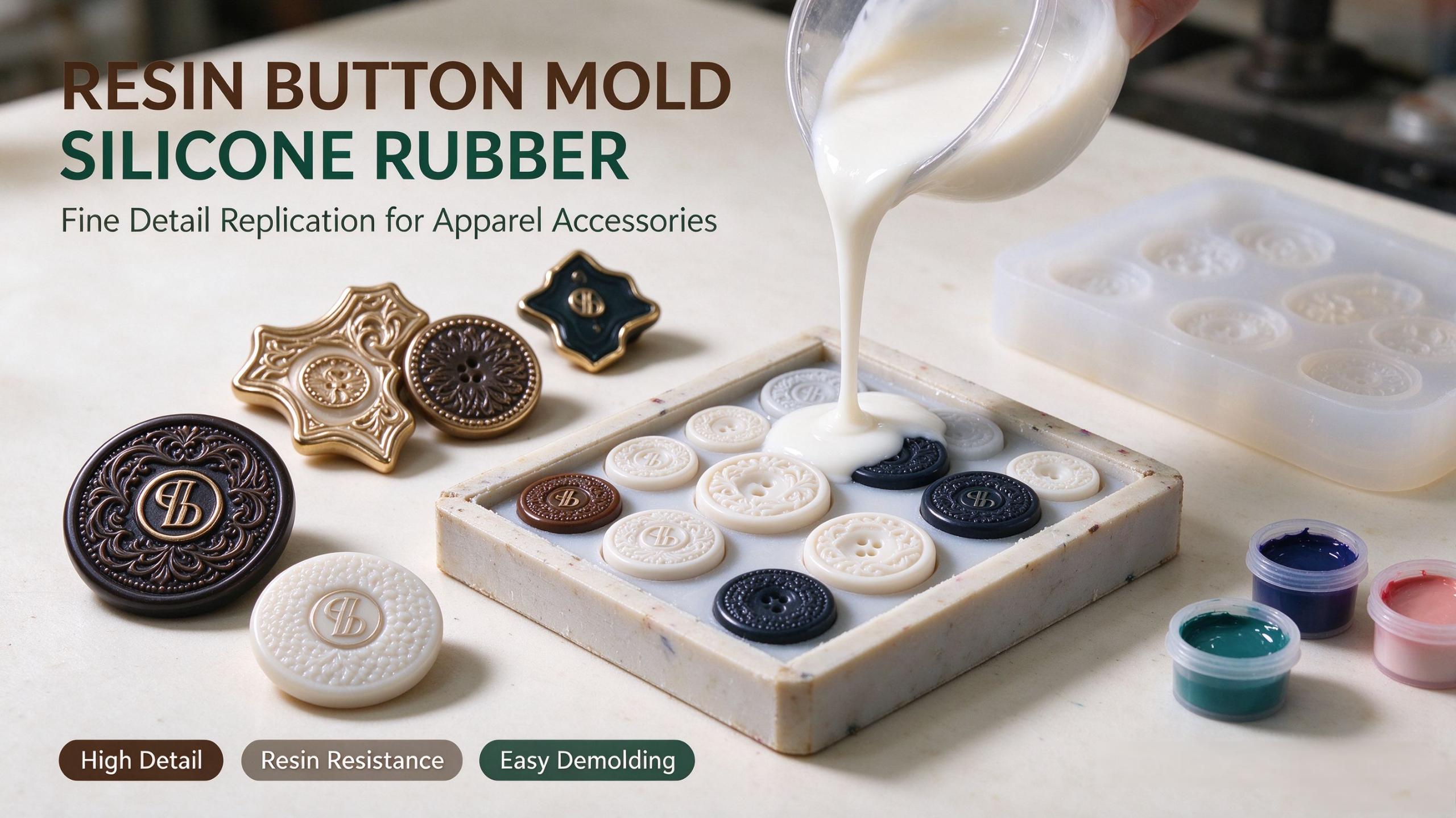
Prototypes of resin buttons usually contain fine patterns, shallow reliefs, logo lines and small grooves, which set high standards for detail reproduction of mold materials. Traditional mold materials tend to lose patterns, blur edges or damage textures during demolding. Resin button mold silicone rubber features moderate fluidity and good self-leveling performance. After mixing and defoaming, it can fully wet fine patterns, shallow reliefs, logo lines and small grooves on button surfaces, precisely restoring original patterns. Finished buttons have clear and sharp patterns without missing edges, blurred patterns or bubble defects, restoring the delicate texture of the original to the maximum.
In terms of material performance, resin button production involves long-term contact with unsaturated resin, epoxy resin and crystal resin casting systems. Ordinary mold silicone tends to be corroded, swell and turn sticky after long-term contact with resin slurry. Mold molding cycles greatly decrease, and frequent mold replacement significantly increases material cost and working hours for accessory factories. This special silicone is formulated for unsaturated resin, epoxy resin and crystal resin. After long-term contact with resin slurry, the cured mold does not easily get corroded, swell or turn sticky, greatly reducing mold scrap probability and effectively extending mold service life.
In terms of mechanical performance, buttons mostly carry small undercuts, thin edges and fine carvings, so the elasticity and tear resistance of silicone are critical during demolding. This condensation RTV2 silicone has good toughness after curing. It does not easily tear or break patterns at small undercuts, thin edges and fine carvings during demolding. With excellent resilience, the mold does not deform in repeated demolding, and buttons have complete edges without burrs. Its linear shrinkage rate is controlled below 0.2%. After curing, dimension remains stable. Mass-produced buttons have uniform specification, ensuring standardized assembly and product consistency of apparel accessories in the same batch.
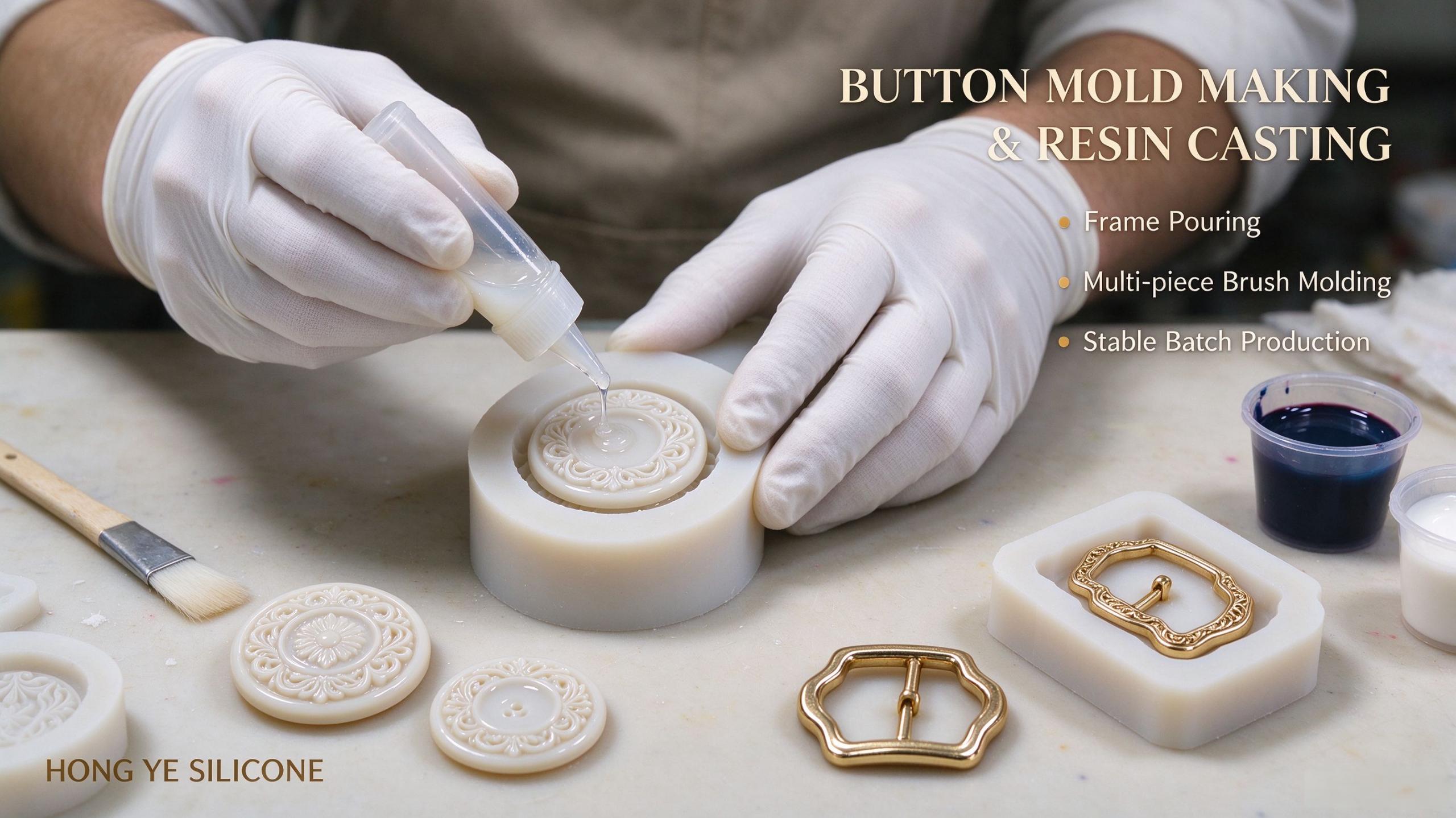
This liquid silicone supports two mainstream molding methods: pouring and multi-piece brush molding. Regular buttons and accessories with relatively simple shapes adopt frame pouring, filling pattern gaps by self-leveling. Complex relief and multi-surface buttons adopt multi-piece brush molding. The first thin layer of silicone is brushed to fully cover patterns, fiberglass cloth is added for reinforcement, and then multiple coats are applied to reach required mold thickness, with parting lines and exhaust grooves planned. The product vulcanizes at room temperature without heating equipment. Whether for fast prototyping in accessory studios or flow line mass production in button factories, it can be operated quickly.
Industry trends show the apparel accessory industry is moving toward personalized customization and flexible production. Orders for custom fashion buttons, IP collaboration buttons and small-batch special-shaped buttons keep rising, featuring small batches, multiple styles and fast updates. Traditional hard molds have long mold opening cycles and high modification costs, which are difficult to adapt to fast iteration. Liquid silicone features short mold opening cycle. After the prototype is modified, the mold can be remade quickly, perfectly matching the fast new product launch and custom order receiving trend in the button industry. Material suppliers keep optimizing formulas, launching button mold silicone grades with different hardness and working time, and improving test reports to meet environmental compliance requirements for domestic and overseas apparel accessory exports.
Industry insiders state that the final quality of resin buttons fundamentally depends on mold quality. High-performance resin button mold silicone rubber helps designers turn button designs into mass-producible products and lower the manufacturing threshold of complex relief buttons. In the future, as the apparel accessory customization market continues to expand, resin button mold silicone rubber technology will keep upgrading and continuously empower innovation in the apparel accessory industry.

August 31, 2026

August 25, 2026

October 27, 2026

October 14, 2026
Email to this supplier
August 31, 2026
August 25, 2026
October 27, 2026
October 14, 2026
Privacy statement: Your privacy is very important to Us. Our company promises not to disclose your personal information to any external company with out your explicit permission.
Fill in more information so that we can get in touch with you faster
Privacy statement: Your privacy is very important to Us. Our company promises not to disclose your personal information to any external company with out your explicit permission.