







Send Message
Privacy statement: Your privacy is very important to Us. Our company promises not to disclose your personal information to any external company with out your explicit permission.
 Shenzhen Hong Ye Jie Technology Co., Ltd
English
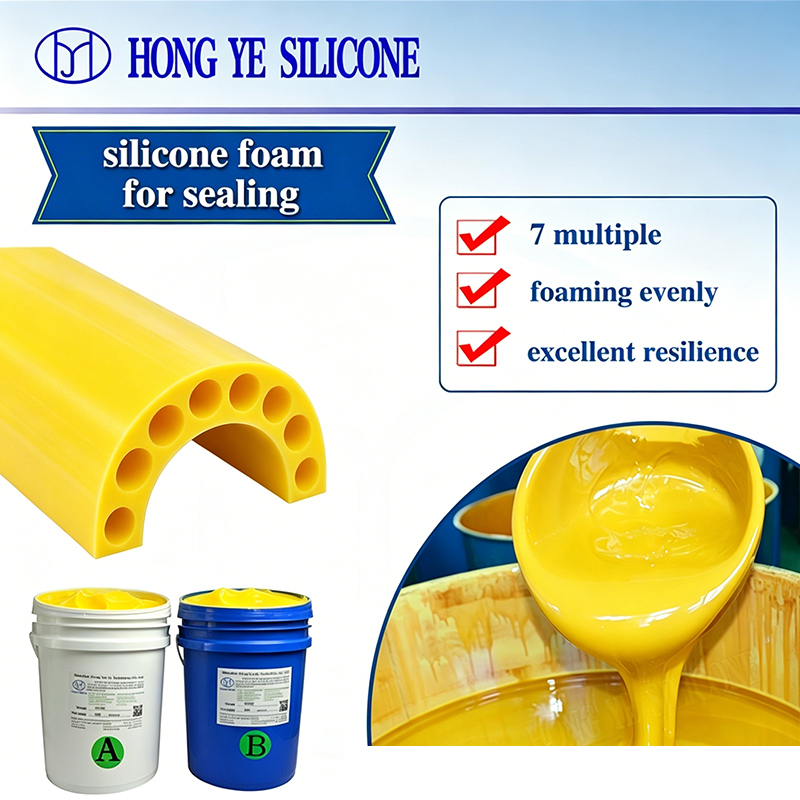
Liquid Silicone Foam is a category of addition-curing, two-component silicone rubber that expands through chemical foaming after A and B components are mixed. It is typically used to produce insoles, shoe cushions, seat pads, mattress toppers, back supports, protective pads, and other flexible silicone rubber products. Compared with conventional polyurethane or latex foams, liquid silicone foam offers better rebound resilience, heat and cold resistance, aging resistance, and chemical inertness, while remaining soft, lightweight, non-toxic, and odorless. This makes it especially suitable for skin-contact applications requiring long service life and consistent performance.
In the footwear and sports sector, insoles, heel cushions, arch supports, and foot pads are often produced using silicone foam for cushioning, pressure distribution, and impact absorption. Silicone foam can maintain its elasticity and support after repeated compression, reproducing the precise softness and rebound required for all-day comfort. At the same time, the closed-cell structure of silicone foam resists sweat and moisture, keeping products dry and hygienic during prolonged use. For manufacturers, suitable silicone foam helps reduce the compression set, odor, and moisture-absorption problems associated with conventional foams, making it more suitable for premium and long-life footwear products.
In the home and healthcare industries, particularly for mattresses, seat cushions, back support pads, baby pillows, breast pads, and elderly care products, skin safety and durability are critical. These products are in direct contact with skin for long periods, so the material must be non-toxic, hypoallergenic, and resistant to moisture and bacteria. Liquid silicone foam offers a uniform cell structure and high rebound, which helps maintain consistent support and comfort throughout years of daily use. At the same time, the non-toxic and skin-friendly nature of silicone foam makes it suitable for sensitive skin, infants, and users with allergies, while its easy-to-clean surface simplifies maintenance.

In comfort and health applications, the performance of silicone foam directly affects user experience and product life. First, the foam must have a high and controllable expansion ratio — typically 2 to 7 times its original volume — so that softness and density can be adjusted to suit different products and body pressures. Second, the cured foam should have uniform cells and excellent rebound so that it recovers its shape after every use without permanent deformation. Third, long-term stability should be excellent, with low linear shrinkage, no migration or shrinking over time, and stable performance over a wide temperature range from -65°C to 200°C. In addition, non-toxicity, hypoallergenic properties, and resistance to moisture and bacteria are essential for skin-contact applications.
The application process for liquid silicone foam generally includes material preparation, mixing of A and B components at a 1:1 ratio, stirring for 2 to 3 minutes, vacuum degassing, pouring into molds, curing, and demolding. When producing thick or large comfort products, flowability and working time are especially important. High-quality liquid silicone foam can maintain a stable viscosity for a sufficiently long working time, allowing operators to mix, degas, and pour properly while avoiding bubbles and voids. For complex shapes, controlled curing temperature, mold pre-treatment, and proper demolding design can further improve surface quality, cell uniformity, and production efficiency.
Today, the healthcare, sports, and consumer markets are demanding not just basic comfort, but also higher hygiene standards, longer service life, and better material safety. Traditional foams often face problems of permanent compression, moisture absorption, odor retention, and limited durability when used in skin-contact products. Liquid silicone foam helps address these challenges through its excellent rebound resilience, non-toxic composition, and moisture resistance, making it particularly useful for premium footwear, health care products, baby products, and hygiene-sensitive consumer goods.

For manufacturers, selecting the right liquid silicone foam can improve product quality, user comfort, and brand reputation while reducing returns, warranty claims, and material waste. As the global market for health and comfort products continues to grow, material upgrades in silicone foam can drive efficiency improvements across the entire production chain. Looking ahead, liquid silicone foam will continue to play an increasingly important role in comfort, healthcare, and skin-contact flexible silicone rubber applications.

October 10, 2026

October 10, 2026

August 31, 2026

August 25, 2026

September 28, 2026
Email to this supplier
October 10, 2026
October 10, 2026
August 31, 2026
August 25, 2026
September 28, 2026
Privacy statement: Your privacy is very important to Us. Our company promises not to disclose your personal information to any external company with out your explicit permission.
Fill in more information so that we can get in touch with you faster
Privacy statement: Your privacy is very important to Us. Our company promises not to disclose your personal information to any external company with out your explicit permission.