







Send Message
Privacy statement: Your privacy is very important to Us. Our company promises not to disclose your personal information to any external company with out your explicit permission.
 Shenzhen Hong Ye Jie Technology Co., Ltd
English
In recent years, the markets for simulation models, teaching aids and automotive cultural ornaments have expanded steadily. Simulation tire models, tread pattern samples, construction vehicle tire ornaments and automotive themed decorations, with highly faithful appearance and strong display value, have become popular categories for model manufacturers, teaching aid makers and cultural brands. Unlike ordinary crafts, a tire model's core value lies almost entirely in tread details. Tread depth, groove direction, sawtooth pattern distribution and shoulder transition angles all directly affect realism and teaching persuasiveness. Any missing tread, collapsed groove or blurred edge makes the model look cheap. As the core carrier of tread molding, the mold material's detail reproduction accuracy, demolding performance and dimensional stability directly determine finished quality and production cost. Tire pattern mold condensation silicone rubber enjoys broad application prospects.
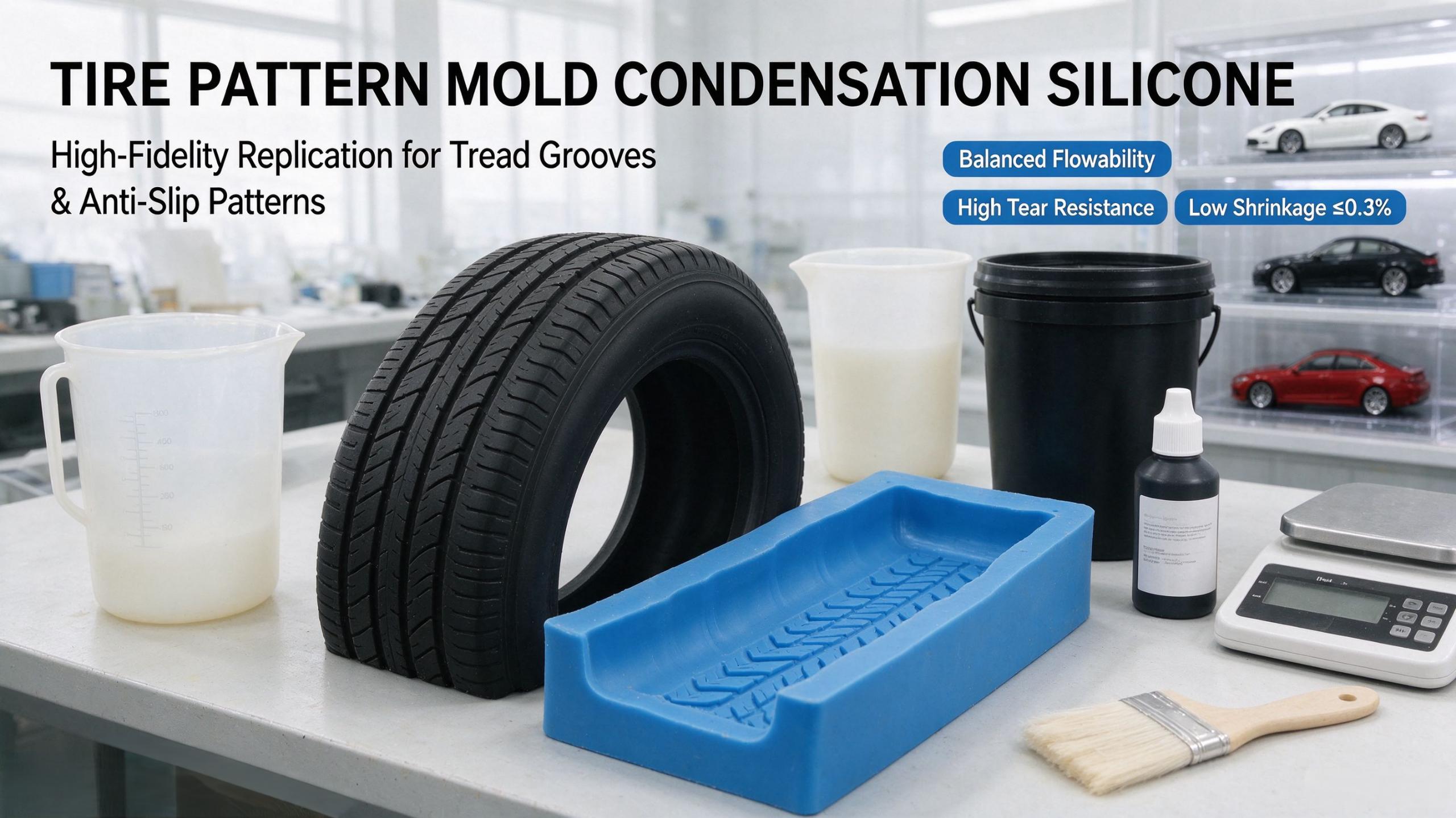
Tire prototypes carry numerous fine structures, including longitudinal main grooves, lateral fine grooves, sawtooth anti-slip patterns, shoulder tread blocks and sidewall lettering reliefs. These share common traits: narrow grooves, great depth, dense spacing and sharp edges, which set high requirements on mold material flowability and wetting. Excessive viscosity prevents compound from reaching groove bottoms and narrow slits, causing missing patterns, broken lines and blurred tread blocks. Excessively low viscosity causes sagging on vertical sidewall surfaces, resulting in locally thin molds that tear during demolding. Tire pattern mold condensation silicone rubber offers balanced flowability. After pouring, it fully fills narrow grooves, sawtooth patterns and tread anti-slip designs, completely reproducing original treads. Finished products have clear patterns and sharp groove boundaries without missing details or bubble breaks, restoring authentic tire texture to the maximum.
In terms of mechanical performance, tire molds differ markedly from other molds. Tread grooves form numerous thin ribs, and the mold itself carries deep undercuts and dense concave-convex structures. During mold opening, repeated bending and pulling concentrate stress on thin ribs and groove edges. Ordinary mold silicone tends to tear and break in such structures, causing local mold scrap. This tire-specific condensation silicone rubber has tear strength of no less than 20 N/mm and elongation of no less than 420%. It combines good elasticity and resilience after curing. Fine tread positions and thin rib structures resist tearing and breaking during demolding. Molds support many replication cycles, significantly reducing mold-making and replacement cost.
In terms of dimensional stability, tire models require high batch consistency. Tread spacing, pattern depth and shoulder contours within the same series must stay uniform to meet assembly and teaching comparison needs of model kits. This silicone rubber controls linear shrinkage within 0.3% with stable dimensions after curing. Batch-replicated tire models maintain high dimensional consistency, and tread spacing and pattern depth do not shift or deform, meeting precision requirements of samples and models while reducing later trimming work.
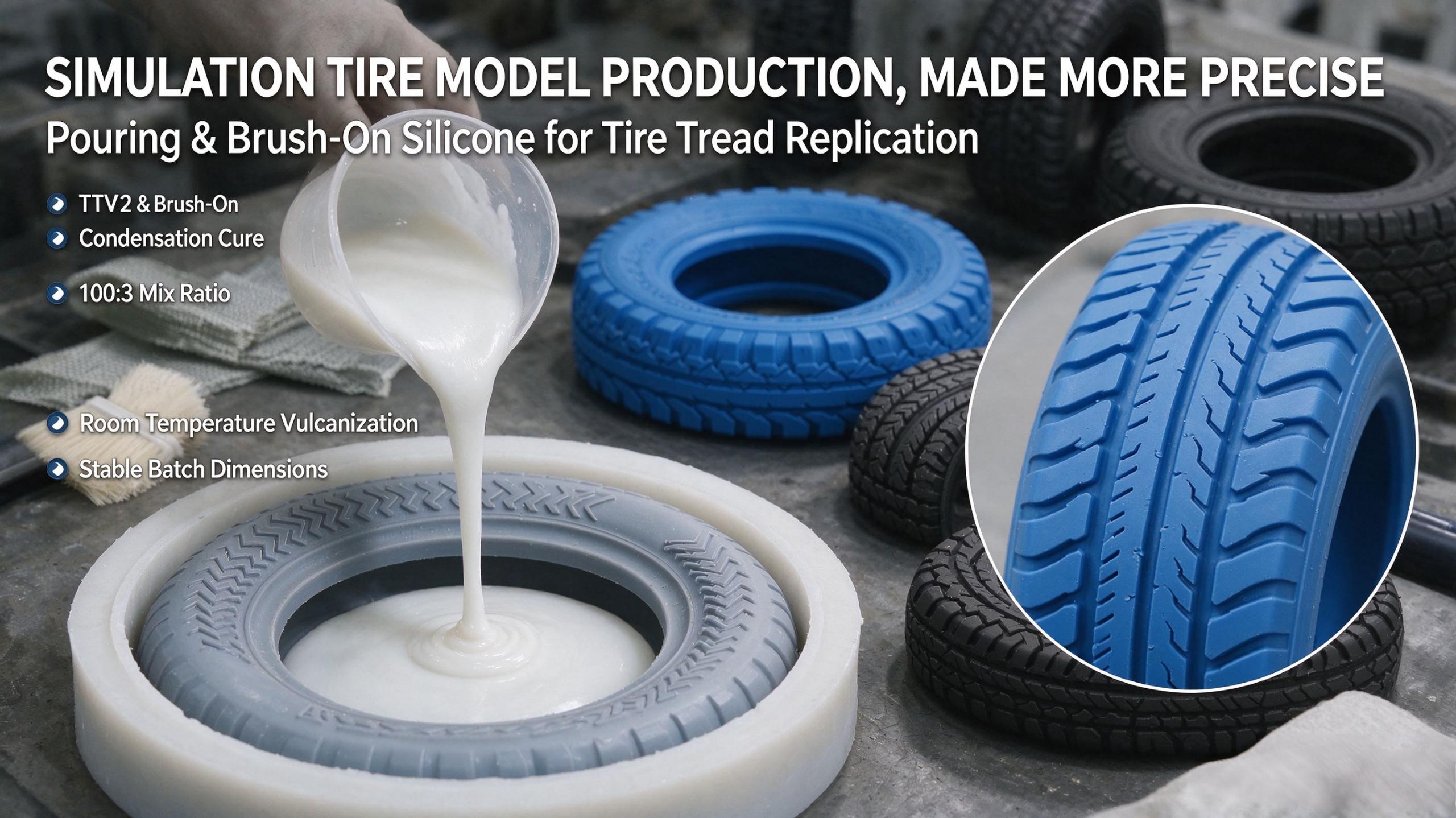
For process adaptability, this liquid silicone supports both pouring and brush-on molding. Small and medium tire models and structurally regular samples can adopt pouring: fix the mold frame and slowly inject from the low point, letting compound self-flow to fill all tread grooves and release bubbles gradually. Large tire prototypes and integral tire molds adopt brush-on molding: apply a thin first layer to ensure every tread groove is filled, then build thickness with multiple coats, optionally with fiberglass cloth reinforcement, and build an external support frame to prevent deformation of large molds. The product vulcanizes naturally at 25℃ and fully cures in 4 to 6 hours without oven equipment, suitable for model factories, teaching aid makers and cultural workshops alike.
In operation, mixing ratio and environmental control directly affect yield. The product is mixed at a weight ratio of Part A to curing agent of 100:3, and can be raised to 100:4 when ambient temperature is below 15℃ to compensate curing speed. After mixing, vacuum defoaming until bubbles fully rise and break is recommended to avoid small bubbles trapped in tread grooves. It should be noted that this product is a condensation-cured system and must not contact addition-cured silicone or sulfur, nitrogen and tin containing materials, which would cause incomplete curing and sticky surfaces. High humidity also affects vulcanization, so the working area should stay dry.
In terms of application matching, this product can be used with resin, PU and gypsum for casting replication. Finished molds resist slurry erosion, castings release easily without sticking, and mold service life is long. The product has passed SGS, ROHS and MSDS compliance testing and can be colored black or gray with silicone pigments, fitting display needs of simulation tire molds and allowing visual inspection of tread details during mold making.
Industry trends show the simulation model and teaching aid sector is moving from small-batch handmade production toward standardized series production. The same tire tread design often requires long-term repeated replication for model kits of different vehicle types and scales, and mold durability directly determines the amortized mold cost per unit. Meanwhile, emerging categories such as cultural ornaments and custom car models bring more small-batch, multi-style orders, requiring short mold opening cycles and flexible modification. Liquid silicone features short mold opening cycles and quick remaking after prototype adjustment, aligning with this trend. Material suppliers keep optimizing formulas, offering grades with different hardness and working time, and improving test reports to meet compliance requirements of model and teaching aid products at home and abroad.

November 18, 2026

August 31, 2026

August 25, 2026

November 16, 2026

November 13, 2026
Email to this supplier
November 18, 2026
August 31, 2026
August 25, 2026
November 16, 2026
November 13, 2026
Privacy statement: Your privacy is very important to Us. Our company promises not to disclose your personal information to any external company with out your explicit permission.
Fill in more information so that we can get in touch with you faster
Privacy statement: Your privacy is very important to Us. Our company promises not to disclose your personal information to any external company with out your explicit permission.