






Send Message
Privacy statement: Your privacy is very important to Us. Our company promises not to disclose your personal information to any external company with out your explicit permission.
 Shenzhen Hong Ye Jie Technology Co., Ltd
English
What tensile strength measures Tensile strength is the stress at which the material breaks when pulled. On a pad, it governs the moment of demoulding, when the pad is stretched away from the part. A pad that fails here splits outright, which is obvious and expensive.
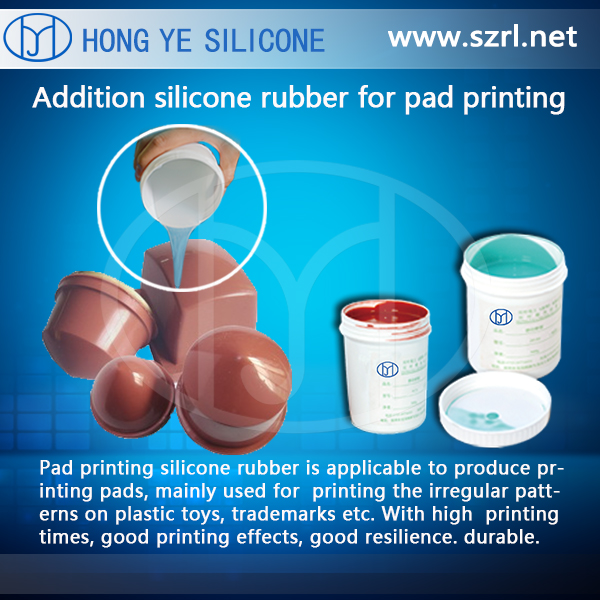
What tear strength measures Tear strength describes resistance to a crack that already started, typically at a nick or an edge. A pad edge that nicks during stripping keeps tearing, and the failure looks like a torn corner rather than a clean split. Tear strength is the number that decides how long an edge survives.
Why they move together but not in step A formulation that raises tensile strength often raises tear strength too, because both depend on network density. But the ratios differ. Two grades can share the same tensile value and behave very differently at the edge, which is why a datasheet with only one of the two numbers tells half the story.
Where each number matters On flat parts with large graphic areas, tensile strength dominates, because the whole pad is stretched at once. On parts with thin features, sharp corners and deep graphics, tear strength dominates, because failure starts at an edge and grows. Choosing a grade on tensile strength alone is how a pad that passes a tensile test still nicks in the press.
The 3.8 and 22 pairing A 3.8 MPa tensile strength with 22±2 kN/m tear strength is a balanced pairing for regular flat and mildly curved graphics, where pads are stripped by hand or by a simple mechanism. Grades with higher tear strength exist in the range, and they make sense where pads are thin, heavily undercut or pulled at an angle.
How to test the pairing in house Mould two pads from the same batch and strip one under production conditions while the other is kept as a reference. If the production pad shows edge nicking before surface wear, the geometry is asking for more tear resistance, not more tensile strength. That single comparison saves a lot of trial purchases.

November 23, 2026

November 23, 2026

August 31, 2026

August 25, 2026

November 16, 2026

November 13, 2026
Email to this supplier
November 23, 2026
November 23, 2026
August 31, 2026
August 25, 2026
November 16, 2026
November 13, 2026
Privacy statement: Your privacy is very important to Us. Our company promises not to disclose your personal information to any external company with out your explicit permission.
Fill in more information so that we can get in touch with you faster
Privacy statement: Your privacy is very important to Us. Our company promises not to disclose your personal information to any external company with out your explicit permission.