







Send Message
Privacy statement: Your privacy is very important to Us. Our company promises not to disclose your personal information to any external company with out your explicit permission.
 Shenzhen Hong Ye Jie Technology Co., Ltd
English
In recent years, the global market for designer toys, collectible figurines, creative ornaments, and craft gifts has continued to expand, with consumers placing ever-higher demands on product detail, surface finish, and sculptural accuracy. In the manufacturing process of these products, the mold serves as the critical link between original design and mass production, and the performance of the mold material directly determines the quality of the final product. Toy and craft mold silicone rubber has become the mainstream mold-making material widely adopted across the figurine, resin ornament, cartoon model, and craft gift industries, thanks to its high-detail reproduction capability, excellent elasticity, and stable physical properties.
Toy and craft mold silicone rubber is a two-component condensation-cure room-temperature-vulcanizing silicone (RTV-2), consisting of a Part A silicone base and a Part B curing agent. After mixing in the specified ratio, it cures at room temperature, and heating can be applied to accelerate curing for different production schedules. Compared with traditional plaster and resin molds, silicone rubber molds offer superior flexibility and elastic recovery. Demolding does not require forceful striking, and complex shapes and undercut structures can be removed intact without damaging the master model or the finished product — making it especially suitable for replicating fine details such as facial expressions, clothing textures, and hair patterns.
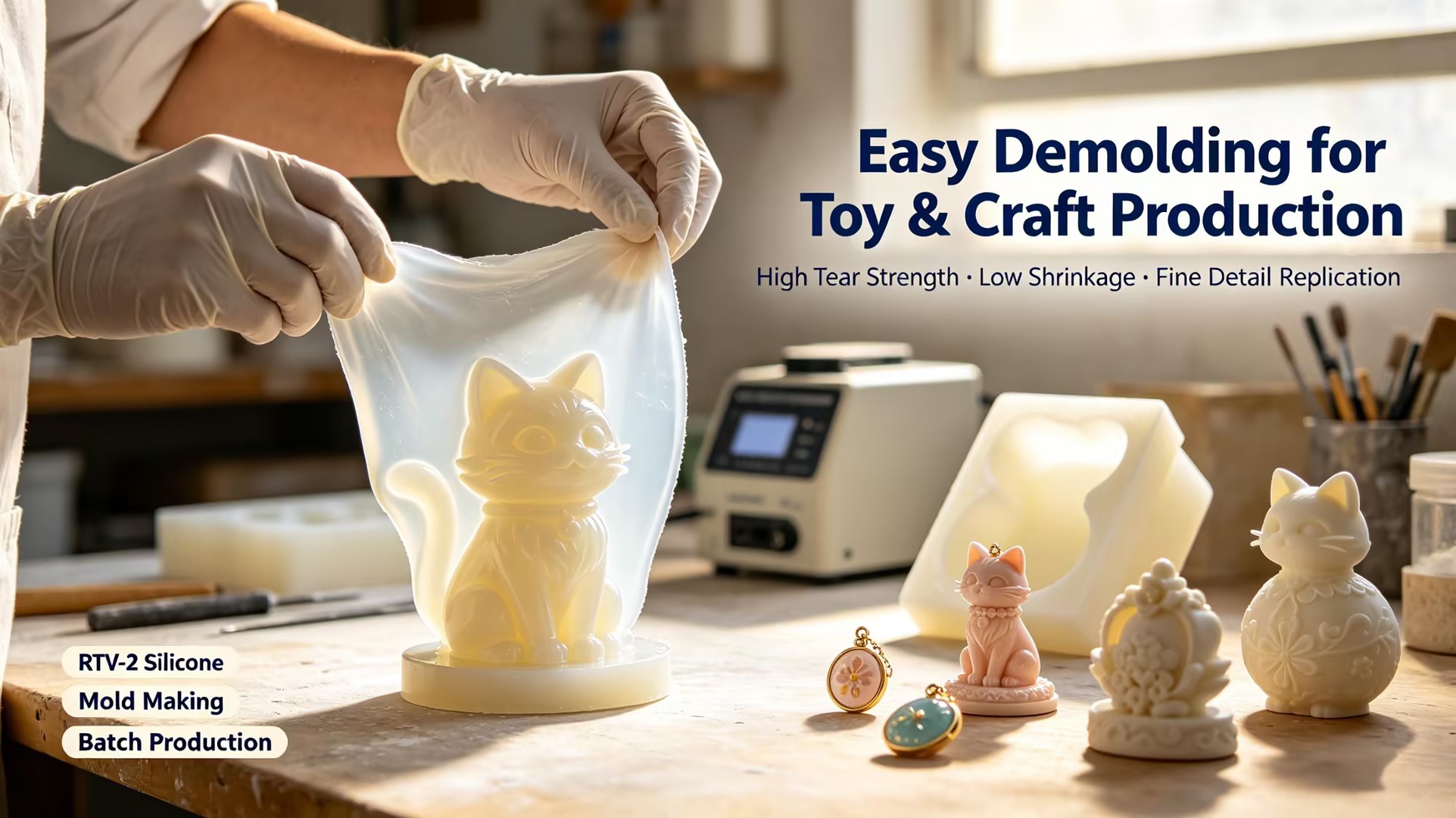
High tear strength is one of the core performance attributes of toy and craft mold silicone rubber. During repeated demolding cycles, edges, thin walls, and protruding sections of the mold are subject to tensile stress. Mold rubber with insufficient tear resistance is prone to cracking, chipping, or even complete tearing, leading to premature mold failure. High-quality toy and craft mold silicone rubber, through optimized formulation, significantly improves tear strength while maintaining good elasticity, allowing a single mold to support dozens or even hundreds of casting cycles and effectively reducing per-unit mold costs for manufacturers.
Low shrinkage is equally critical. Toys and craft products often have strict requirements for dimensional accuracy and sculptural proportion. Excessive curing shrinkage can cause noticeable deviations between the finished product and the original model, compromising detail fidelity and batch consistency. Condensation-cure mold silicone controls the crosslinking reaction system to keep the curing linear shrinkage rate at a low level, ensuring stable mold cavity dimensions so that every product in a production run maintains the same proportions and surface details as the original master.
Good flowability allows the silicone to flow naturally during pouring, fully wetting the fine textures and recessed structures on the master model surface and reducing trapped air bubbles and incomplete filling. For figurine prototypes with complex curves, fine patterns, or deep cavity structures, highly flowable mold silicone — assisted by vacuum degassing — can replicate every detail completely, avoiding defects such as pores, incomplete filling, or blurred textures in the mold, thereby ensuring the surface quality of subsequent cast products.
In practical applications, the operational process for toy and craft mold silicone rubber typically includes master model preparation, release agent application, A/B component weighing and mixing, vacuum degassing, pouring or brushing, room-temperature curing, demolding, and mold maintenance. The master model surface should be clean and dry, and a release agent may be applied when necessary to facilitate later demolding. Parts A and B must be weighed strictly according to the product specification's weight ratio, stirred thoroughly, and then vacuum-degassed to eliminate bubbles introduced during mixing. After degassing, the silicone is poured into the mold container containing the master model and left to cure at room temperature before careful demolding. Proper operational procedures and mold maintenance can significantly extend mold service life and maintain stable replication accuracy.
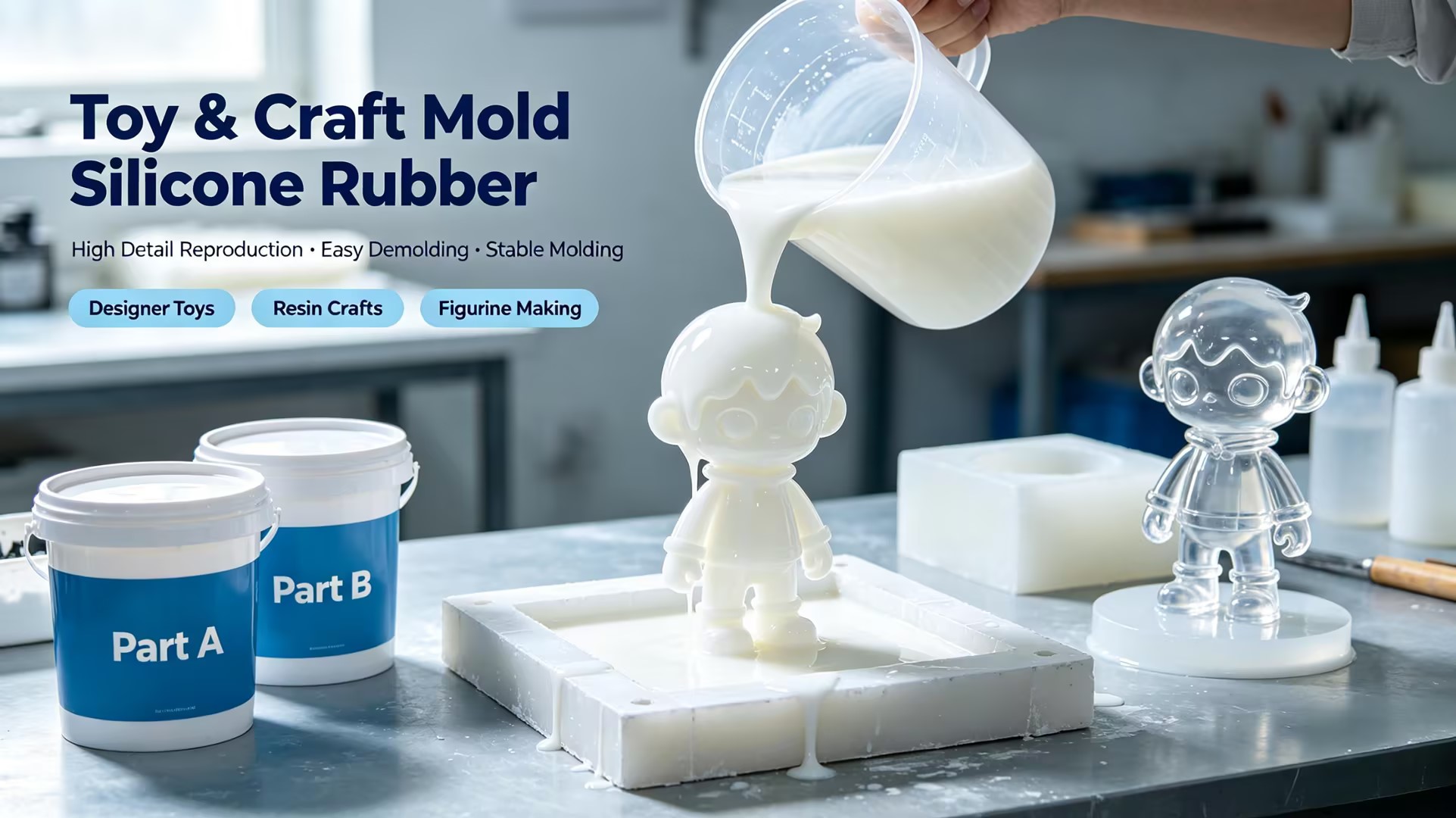
The application scenarios for toy and craft mold silicone rubber are extensive. In the designer toy and collectible sector, it is used to create molding tools for blind-box figurines, premium collectibles, and designer toys. In the resin craft industry, it applies to jade-like ornaments, Buddha sculptures, decorative pendants, scented plaster, and candle molds. In the creative gift sector, it supports small-batch production of custom badges, fridge magnets, desktop ornaments, and seasonal gifts. Additionally, it is widely used in consumer-level scenarios such as cake decoration, soap making, and DIY crafts, demonstrating remarkable versatility.
Compared with other mold materials, the comprehensive advantages of toy and craft mold silicone rubber are clear. Plaster molds are low in cost but brittle, easily damaged, poor in detail reproduction, and not reusable. Resin molds are hard but lack flexibility, making demolding of complex structures difficult and risking damage to finished products. Silicone rubber molds combine elasticity, toughness, and durability — they can replicate fine details while supporting repeated use, making them an ideal choice that balances quality and cost.

August 31, 2026

August 25, 2026

September 14, 2026

September 11, 2026
Email to this supplier
August 31, 2026
August 25, 2026
September 14, 2026
September 11, 2026
Privacy statement: Your privacy is very important to Us. Our company promises not to disclose your personal information to any external company with out your explicit permission.
Fill in more information so that we can get in touch with you faster
Privacy statement: Your privacy is very important to Us. Our company promises not to disclose your personal information to any external company with out your explicit permission.