



High Temperature Oven Hot Air Filter Gel Seal
$12-20 /
| Min. Order: | 1 |
Share:


 Shenzhen Hong Ye Jie Technology Co., Ltd
English
The file is encrypted. Please fill in the following information to continue accessing it
Product Overview:
Hong Ye HY-9400 is a premium two-component addition-cure platinum catalyzed blue jelly gel specifically engineered for sealing hot-air circulation filters in industrial curing ovens, tunnel dryers and coating lines that run at sustained elevated temperature. With a buttery soft consistency measured at a penetration of 200 plus or minus 30 (0.1mm) and a durably tacky surface, HY-9400 delivers reliable long-life sealing and protection that outlasts conventional gaskets, foams and caulks by a wide margin. The product is mixed 1:1 by weight, self-levels after pouring, cures at room temperature within 4 to 6 hours, and requires no vacuum degassing, making it a straightforward high-performance gel to deploy on production lines worldwide. As a low viscosity fast flow grade, this variant pours easily into narrow channels and complex cavities, levels quickly with minimal bubbles, and is optimized for automated meter-mix dispensing on high-speed lines. It is designed for filter housings in hot-air circulation ovens and tunnel dryers used in electronics curing, powder coating and composite processing, where the seal sees continuously elevated air temperatures. The silicone gel remains soft and in place up to 200C without flowing, hardening or losing seal integrity far beyond the limits of organic gels. (EN) Backed by Hong Ye’s nearly 20 years of silicone manufacturing expertise and supplied to customers in over 60 countries, HY-9400 combines the performance of premium imported gels with the cost efficiency, short lead time and responsive technical support of a Chinese manufacturer. Whether you are running a first sample trial or ramping to full production, Hong Ye delivers consistent batch-to-batch quality, comprehensive documentation and application engineering support from first sample through full production.

Key Features:
• Low viscosity fast flow formulation fills narrow gaps and intricate cavities quickly, self-levels with minimal bubbles and suits automated dispensing.
• Excellent electrical insulation with dielectric strength above 20 kV/mm
• Repairable and reworkable: old gel can be topped up with fresh gel without full removal
• No VOC emissions during or after cure, suitable for enclosed cleanroom and medical environments
• Can be heat-cured at 60-80C for 30-60 minutes to shorten demolding time in mass production
• Resistant to ozone, UV, moisture, salt spray and common cleanroom cleaning agents
• 1:1 mix ratio by weight, easy to meter with manual or automated dispensing equipment
• Compatible with automated meter-mix dispensing equipment for high-volume production lines
• 12 month shelf life when sealed and stored below 25C in dry ventilated conditions
• Third-party test reports including RoHS, REACH, FDA and LFGB available on request
• Self-leveling after pouring, no vacuum degassing required, saving process time and equipment
• Recommended model: HY-9400 - Blue high tack tank sealant jelly gel
Technical Parameters:
Detailed Application Scenarios:
Industrial curing ovens, tunnel dryers, powder-coating cure tunnels and composite post-cure chambers circulate large volumes of hot filtered air to maintain temperature uniformity and product cleanliness. The intake and recirculation filters in these systems are sealed into housings that run hot for long production runs. Organic polyurethane gels and conventional gaskets soften, sag or embrittle under sustained heat, leading to bypass and contamination. HY-9400 addition-cure silicone gel retains its soft, jelly-like consistency and seal pressure continuously at temperatures up to 200C, with no thermal sag, cracking or tack loss, giving oven operators a long-life sealing solution.
The gel also tolerates the rapid thermal cycling of batch oven operation and the thermal expansion mismatch between metal housings and filter frames, absorbing movement instead of tearing. During maintenance, filters can be changed while the housing is warm-to-cool, and the self-healing gel re-seats around the new knife edge without re-pouring. Hong Rey provides application guidance on the continuous service temperature, gel depth for hot channels and heat-cure scheduling during installation, plus standard RoHS/REACH and COA documentation for industrial equipment OEMs.
Application & Operating Instructions:
Step 1 Surface preparation: Clean the gel channel with a dry lint-free cloth. Remove all oil, water, rust, latex residue and old cured silicone fragments. For new housings, wipe with isopropyl alcohol and allow to fully dry.
Step 2 Component B preparation: Before each use, stir component B thoroughly for at least 2 minutes. The pigment and catalyst can settle during storage; incomplete stirring causes color variation and soft or uncured spots.
Step 3 Weighing and mixing: Weigh A and B at exactly 1:1 by weight using a calibrated scale. Pour into a clean mixing container and stir slowly for 3 to 5 minutes, scraping the sides and bottom regularly. Avoid fast stirring which introduces bubbles.
Step 4 Pouring: Pour the mixed gel slowly along one end of the channel and allow it to self-level to a depth of 15 to 25mm. Do not pour from a height to avoid air entrapment. For long channels, pour in sections.
Step 5 Curing: Allow 4 to 6 hours at 25C before installing the filter. Full physical properties develop after 24 hours. No vacuum degassing is required.
Step 6 Contamination prevention: Use polyethylene, nylon or nitrile gloves. Never use natural rubber latex gloves. Avoid contact with sulfur-containing materials, amines, phosphorus compounds, tin-cured silicone and PVC, as these can inhibit the platinum catalyst and prevent cure.
Model Selection Guide:
The HY-94 series offers three standard grades to cover the full range of jelly gel applications, and custom formulations are available for volume orders:
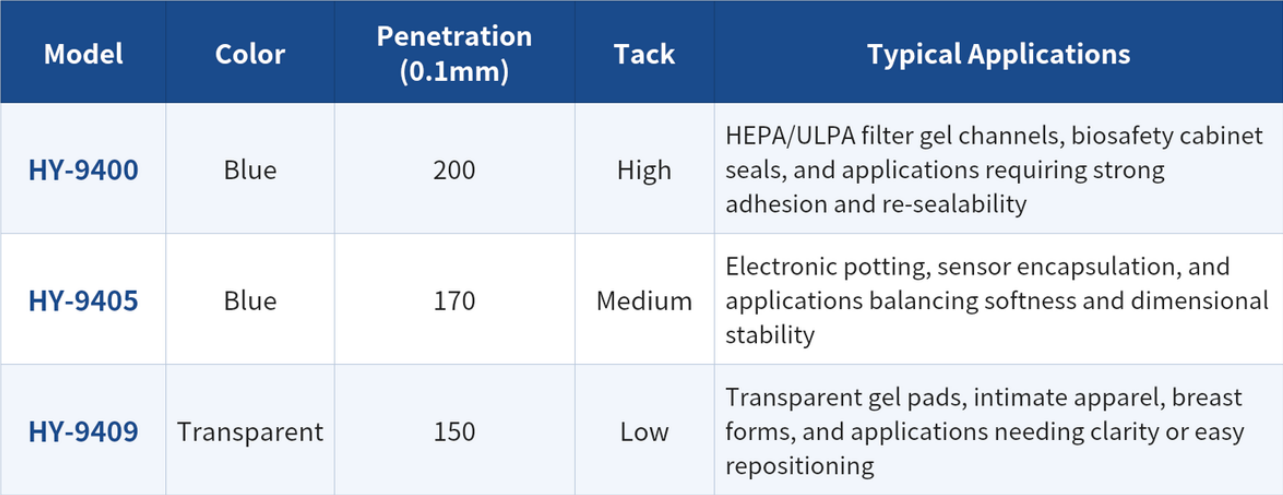
HY-9400 (Blue, High Tack, Penetration 200): The soft, high-tack grade, designed for HEPA/ULPA filter gel seals in cleanrooms, biosafety cabinets, pharmaceutical GMP facilities, hospital operating rooms, semiconductor fabs, lithium battery dry rooms and data centers. Choose this model when strong self-healing and conformability to knife-edge channels are key requirements.
HY-9405 (Blue, Medium Tack, Penetration 170): The balanced all-rounder for instrument meter sealing, electronic encapsulation and outdoor waterproofing. Typical applications include smart water/gas/electric meters, automotive ECUs and sensors, solar PV junction boxes, LED modules, underwater lights, battery management systems and pressure sensors. Choose this model when you need a combination of flowability, structural support, vibration damping and repairability.
HY-9409 (Transparent, Low Tack, Penetration 150): The premium skin-contact grade for intimate apparel and medical products. Typical applications include silicone bra pads, push-up inserts, breast prostheses, nipple covers, bridal and swimwear gel pads, orthopedic insoles, baby products and surgical positioning pads. Choose this model when clarity, dry skin feel, anti-yellowing and body-safe materials are required.
If your project requires a different penetration, color, cure speed or special certification (FDA, LFGB, UL94), contact Hong Ye technical support for a custom formulation. Custom MOQ starts from 20kg and typical lead time is 7 to 10 working days.
Recommended Application: High Temperature Oven Hot Air Filter Gel Seal
Packaging:
Standard packaging options include 1kg trial kits (500g A + 500g B), 5kg kits, 20kg pails, 25kg pails and 200kg drums. Components A and B are supplied in separate containers within each kit. Custom packaging and private labeling are available for orders above 200kg. All kits are clearly labeled with batch number, manufacture date, expiry date and safety information.

Precautions:
Use polyethylene, nylon or nitrile gloves; never use natural rubber latex gloves. Avoid contact with sulfur-containing materials, amines, phosphorus compounds, tin-cured silicone and PVC, as these inhibit the platinum catalyst and prevent cure. Mix A and B at exactly 1:1 ratio by weight using a calibrated scale. Stir thoroughly for 3-5 minutes, scraping container walls and bottom. Do not exceed 100C during heat curing. Ensure good ventilation during operation.
Storage:
Store sealed containers in a dry, ventilated area below 25C, away from direct sunlight, sulfur-containing materials, amines, food and strong chemicals. Shelf life is 12 months from manufacture date. Reseal unused material immediately after dispensing. Refrigerated storage at 5-15C can extend shelf life; allow material to return to room temperature before opening to prevent condensation.
FAQ:
Q: How long does the gel take to cure and can I speed it up?
A: At 25C the gel reaches touch-dry in 4 to 6 hours and full properties after 24 hours. For mass production, heat-curing at 60 to 80C reduces demolding time to 30 to 60 minutes. Do not exceed 100C as it may cause discoloration or surface defects. Low temperatures below 15C will significantly slow the cure.
Q: Will the gel self-heal after a filter is removed and reinserted?
A: Yes. The cured gel remains durably tacky and soft. When the knife edge is lifted, the gel temporarily separates; when reinserted, it flows back around the blade within minutes, restoring the airtight seal. This self-healing property is a key advantage over compressed gaskets and is especially valuable during periodic filter replacement.
Q: What is the shelf life and how should the gel be stored?
A: Sealed containers have a 12 month shelf life when stored below 25C in a dry, ventilated area away from direct sunlight. Reseal unused material immediately. Keep components A and B separate and away from sulfur-containing materials, amines, food and strong chemicals.
Q: Can old gel in a filter tank or housing be topped up?
A: Yes. If the existing gel is still clean, soft and tacky, wipe the surface with a dry cloth and pour fresh gel on top. The fresh addition-cure gel bonds chemically to the clean cured gel. If the old gel has hardened, dried out, yellowed or become contaminated, remove it completely, clean the channel and refill.


Privacy statement: Your privacy is very important to Us. Our company promises not to disclose your personal information to any external company with out your explicit permission.
Fill in more information so that we can get in touch with you faster
Privacy statement: Your privacy is very important to Us. Our company promises not to disclose your personal information to any external company with out your explicit permission.



 Contact Now