







Send Message
Privacy statement: Your privacy is very important to Us. Our company promises not to disclose your personal information to any external company with out your explicit permission.
 Shenzhen Hong Ye Jie Technology Co., Ltd
English
Driven by high-end real estate, cultural tourism landscapes and old city renovation, the market for European GRC cement components and gypsum decorative parts has recovered steadily. Roman columns, cornices, pediments, window casings, waist lines and exterior wall reliefs, with their elegant shapes and rich layering, are widely applied to facades of high-end villas, commercial complexes, cultural tourism buildings and European-style residential projects. As architectural aesthetics upgrade, designers increasingly adopt complex relief shapes such as scrollwork, volute patterns and roman carvings. GRC manufacturers and decoration contractors have raised higher standards on mold detail reproduction, dimensional stability and alkali resistance. As a core mold-making material, European GRC gypsum mold silicone from Hong Ye Silicone gains increasing importance in the industrial chain.
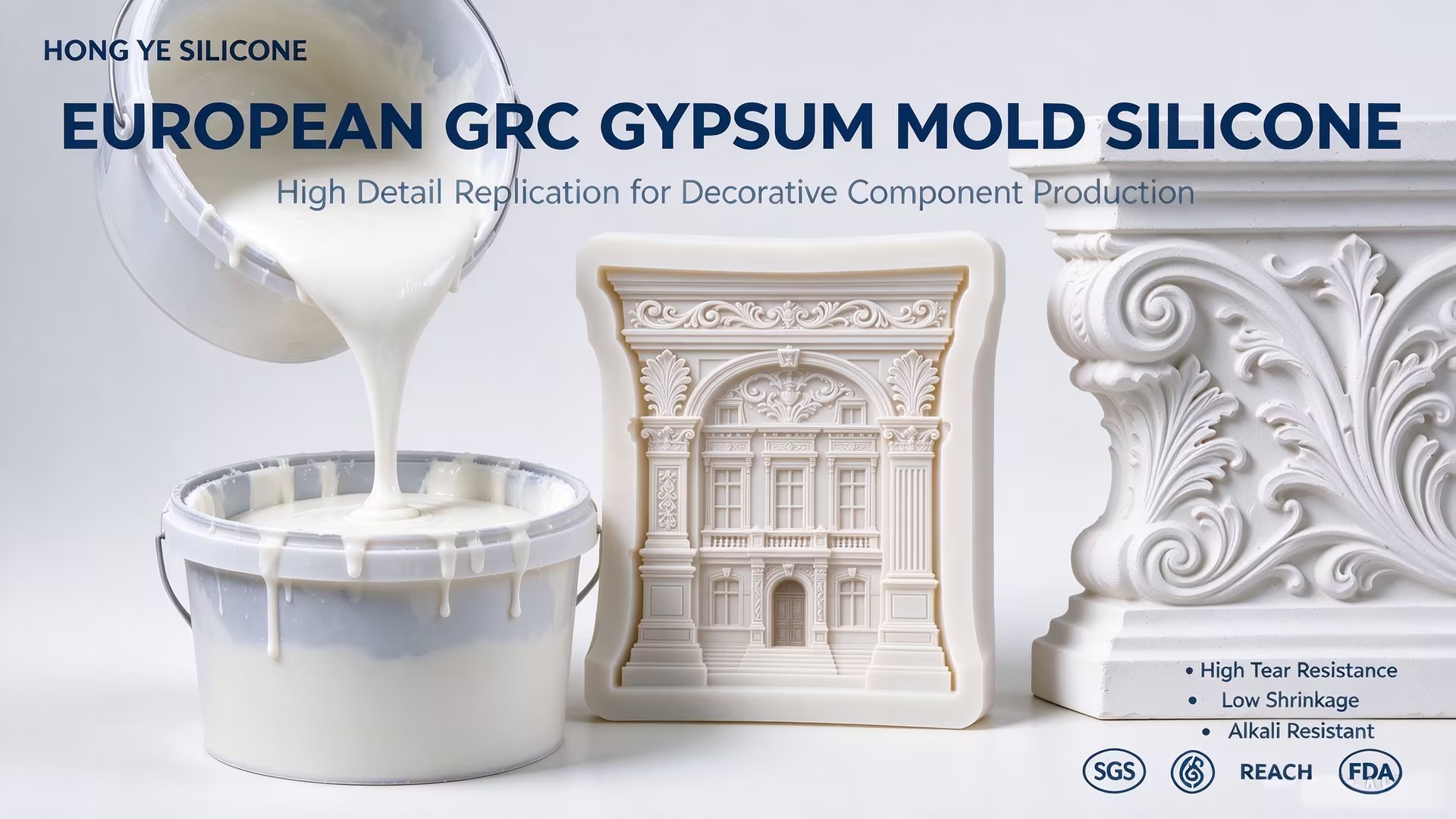
European GRC and gypsum component production has special working conditions. Both gypsum slurry and GRC cement slurry are alkaline systems. Long-term contact with gypsum and cement slurry will erode ordinary general-purpose mold silicone, leading to sticky surface, reduced elasticity and decreased tear strength. The mold can only be reused for a small number of times. Frequent mold replacement greatly increases material cost and working hours for component factories. In addition, European components span large dimensions. For long cornices, roman columns and large-area wall reliefs, poor shrinkage control of silicone will cause dimensional deviation and warpage, failing to meet assembly tolerance standards on construction sites.
European GRC gypsum mold silicone from Hong Ye Silicone is two-component Liquid silicone rubber, including condensation-cured and high-end addition-cured series, with formula optimized for gypsum and cement casting. With excellent fluidity and self-leveling performance, the product can fully wet the prototype surface after mixing and defoaming. It penetrates complex deep and shallow patterns such as scrollwork, volute patterns and roman carvings, faithfully reproducing European relief shapes. Finished components have smooth and clear lines without missing patterns, corners or bubble defects. Its linear shrinkage rate is controlled below 0.3%, ensuring stable dimension after curing. Mass-produced roman columns, cornices and window casings maintain consistent size, reducing later repair work and ensuring assembly precision on construction sites.
In terms of mechanical performance, this molding silicone delivers high tear resistance and good resilience. European components often carry sharp corners, thin lace edges and deep relief structures. Molds need repeated bending during demolding. High tear-resistant formula effectively prevents edge chipping and tearing of thin sections when stripping. Cured silicone possesses outstanding alkali resistance. After repeated contact with alkaline gypsum and cement slurry, it resists aging and stickiness. One silicone mold can produce dozens of components steadily, greatly reducing repeated mold-making cost and improving delivery efficiency of component manufacturers.
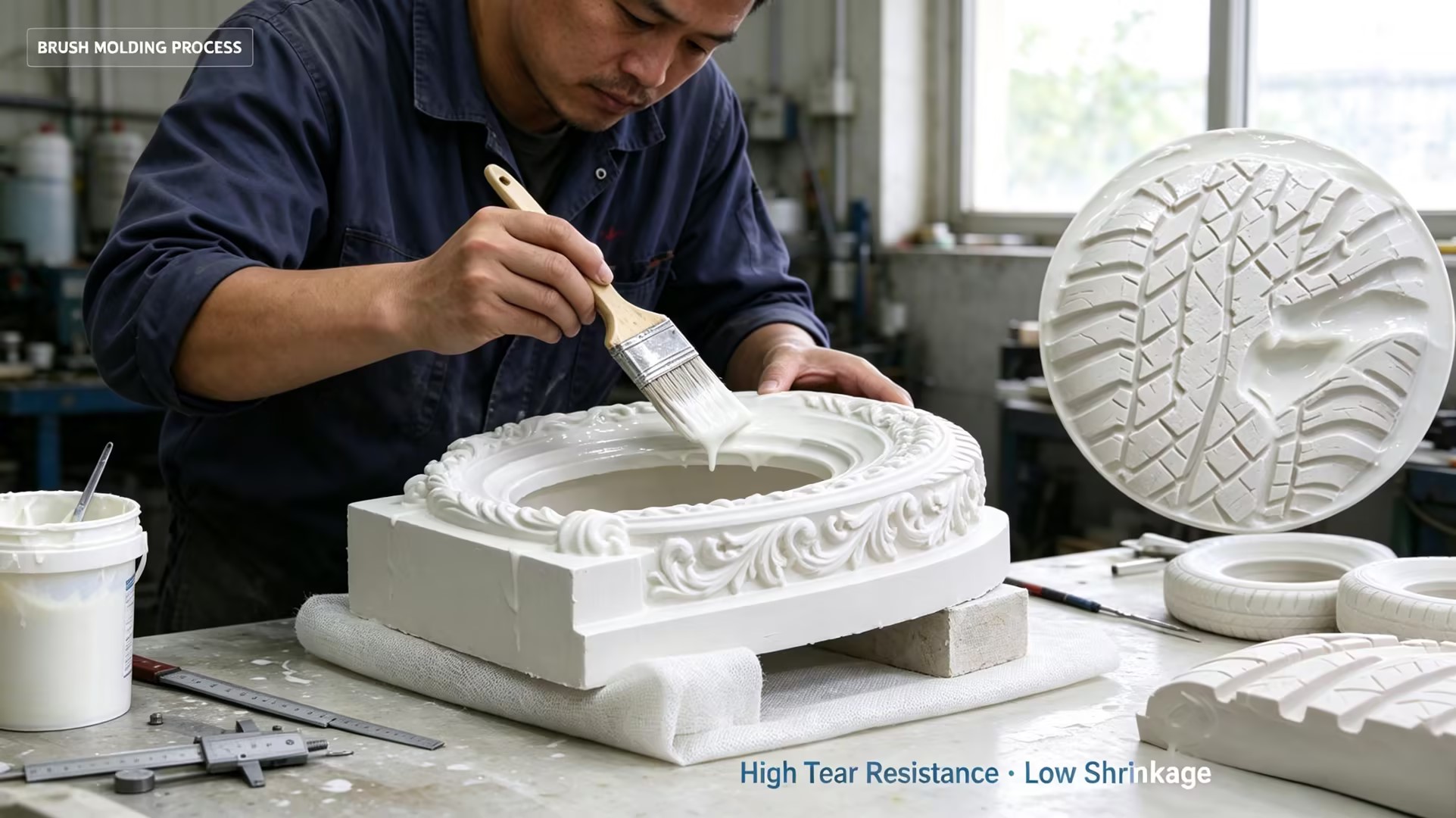
For construction adaptability, this liquid silicone supports two mainstream molding methods: multi-piece brush molding and frame pouring. For large pediments, deep reliefs and long cornices, layered brush molding is widely adopted. Silicone is applied in multiple coats with fiberglass cloth reinforcement, and gypsum or FRP hard outer shell is made to support the mold and avoid deformation. Small and medium waist lines and flower parts with simple shapes can be cast directly with frame, easy to operate. Room temperature curing eliminates heating equipment. It can be applied by small building material factories as well as large precast component production bases and decoration construction sites.
Industry trends show the global architectural decoration sector is moving toward customization. Custom European component orders from cultural tourism projects, commercial complexes and retro style renovation keep rising. Components become larger and shape complexity increases. Downstream manufacturers focus not only on raw material price, but also on comprehensive indicators including mold lifespan, finished product yield and dimensional stability. Hong Ye Silicone keeps optimizing formulas, launching European GRC gypsum silicone grades with different hardness and pot life for projects ranging from small carved ornaments to several-meter-long large exterior wall decorations. Test documents are continuously upgraded to satisfy environmental compliance requirements of domestic and overseas construction projects.

August 31, 2026

August 25, 2026

October 14, 2026

September 28, 2026
Email to this supplier
August 31, 2026
August 25, 2026
October 14, 2026
September 28, 2026
Privacy statement: Your privacy is very important to Us. Our company promises not to disclose your personal information to any external company with out your explicit permission.
Fill in more information so that we can get in touch with you faster
Privacy statement: Your privacy is very important to Us. Our company promises not to disclose your personal information to any external company with out your explicit permission.