







Send Message
Privacy statement: Your privacy is very important to Us. Our company promises not to disclose your personal information to any external company with out your explicit permission.
 Shenzhen Hong Ye Jie Technology Co., Ltd
English
Nowadays, new product iteration speeds up continuously in consumer electronics, small home appliances, smart equipment and decorative accessories industries. Before formal injection mold manufacturing, prototype models, plastic samples and functional verification parts are essential in the R&D process. ABS housings, special-shaped plastic parts, structural buckle parts and decorative plastic ornaments require fast replication of prototypes for assembly testing and appearance review. Traditional CNC machining suffers from long lead time and high cost, which cannot meet the demand of rapid modification for multiple versions. Liquid silicone molding has become the mainstream process in the prototype industry thanks to low cost, fast mold opening and flexible revision. RTV-2 liquid silicone for plastic part molding is developed to meet strict structural requirements of plastic component replication.
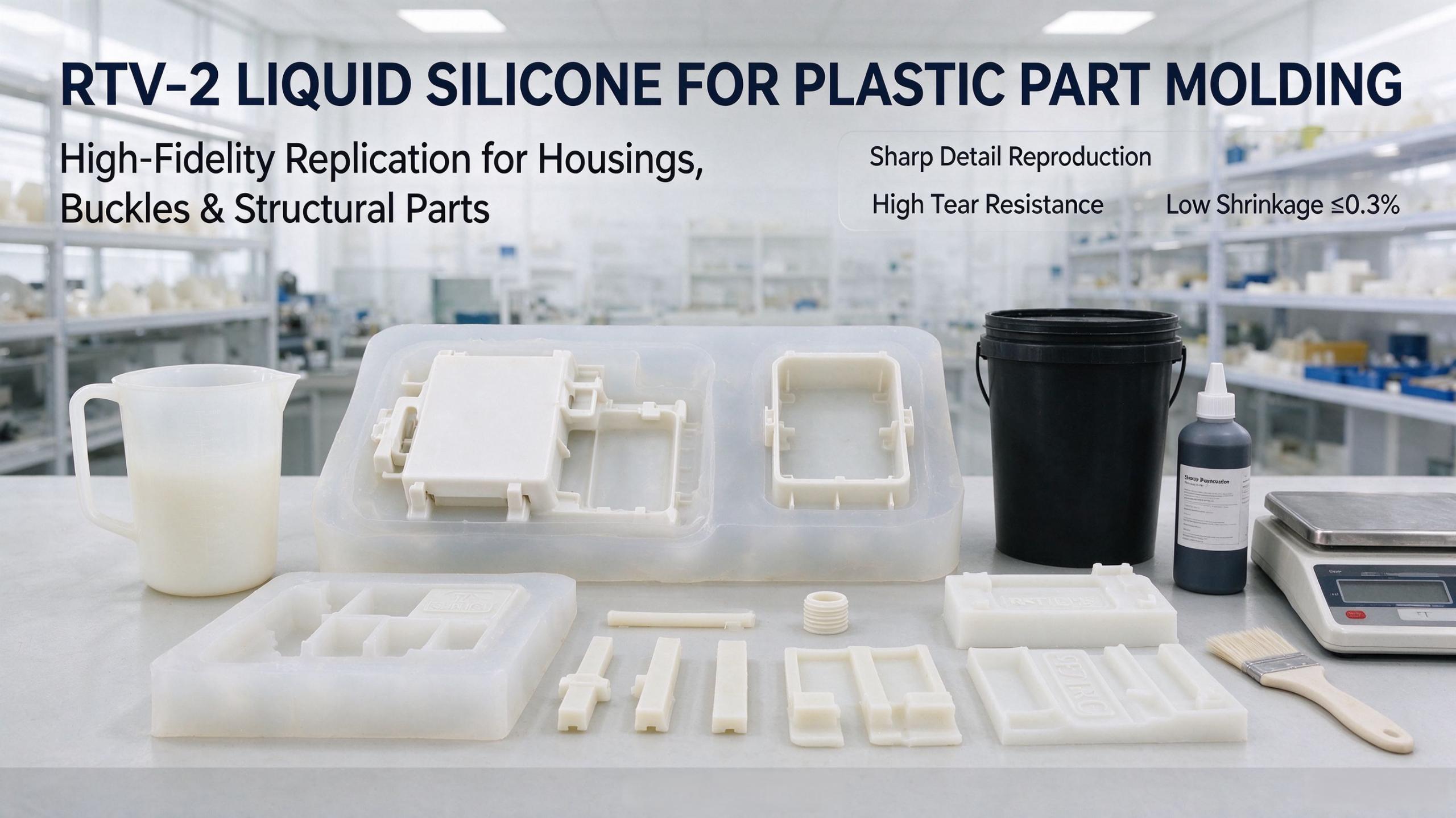
Different from ordinary crafts, plastic prototypes usually contain numerous fine functional structures: assembly buckles, positioning grooves, reinforcing ribs, thread slots, embossed logos and thin-wall steps. These structures have narrow gaps and varying depths, and many ribs are extremely thin, setting high requirements on the wetting and filling capacity of silicone. Insufficient flowability prevents silicone from reaching the bottom of ribs and buckle gaps, resulting in incomplete patterns and blurred outlines, which directly leads to assembly failure. Excessively runny silicone will sag and form uneven mold thickness, causing damage under demolding stress. RTV-2 liquid silicone for plastic part molding delivers balanced self-leveling performance. After mixing, it flows gently to fully wet all tiny grooves and ribs and release trapped air bubbles. The reproduced plastic parts have sharp outlines with intact buckles, threads and marks, greatly reducing post-processing and polishing work.
In terms of mechanical performance, the biggest challenge of plastic structural part molds is the large number of undercuts, thin ribs and buckles. During demolding, the silicone mold is repeatedly stretched and bent. Thin ribs bear continuous tensile stress, and ordinary silicone tends to tear and crack at rib grooves. Frequent mold remaking increases prototyping cost greatly. This condensation RTV-2 liquid silicone has tear strength ≥20 N/mm and elongation ≥430%. It features excellent elastic resilience after curing. It provides stronger resistance to pulling for buckles, thin walls and deep undercuts. The mold resists cracking after multiple replication cycles, extending service life and ideal for repeated sample verification of the same plastic part.
Dimensional stability is the core requirement for plastic prototype replication. Plastic parts in R&D need precise assembly fit. Excessive dimensional deviation will cause tight fitting or excessive gaps, failing functional tests. This silicone keeps linear shrinkage within 0.3%, with minimal deformation after curing. Multiple samples produced in one batch feature consistent dimensions. Outer shape, hole spacing and buckle distance stay stable and controllable, ensuring reliable assembly tolerance data for engineers.
For process adaptability, this RTV-2 liquid silicone supports both pouring and brush-on molding. Small and medium-sized regular plastic parts are suitable for pouring: build the mold frame and inject slowly from the low point to fill the cavity and release air naturally. Large appliance housings and complex prototypes with deep undercuts adopt brush-on molding. Apply a thin first coat to fully cover every groove and rib, then build up thickness layer by layer. Fiberglass cloth reinforcement and outer support frame can be added to prevent mold expansion and deformation. The product vulcanizes naturally at 25℃ and fully cures within 4–6 hours, no oven heating required. It is easy to operate for prototype studios and R&D laboratories.
The finished silicone molds can be used for casting PU resin, epoxy resin and gypsum. They release cast parts smoothly without sticking and resist erosion from casting slurry. The product has passed SGS, ROHS and MSDS compliance tests for environmental safety. Silicone pigments can be added for coloring, so operators can visually check filling status and quickly spot unfilled areas or bubbles inside the mold.
In practical operation, mixing ratio, defoaming and ambient humidity directly affect mold quality. The recommended mixing ratio by weight is Part A : curing agent =100:3. When ambient temperature is below 15℃, curing slows down and the ratio can be adjusted to 100:4. Stir thoroughly including the bottom and side walls of the bucket, then vacuum defoam to eliminate bubbles and avoid pinhole defects on ribs. This is a condensation RTV2 system. Contact with addition-cured silicone or sulfur, nitrogen, tin-containing substances must be avoided, otherwise incomplete curing and sticky surface will occur. The working area should be dry, as high humidity will interfere with vulcanization.
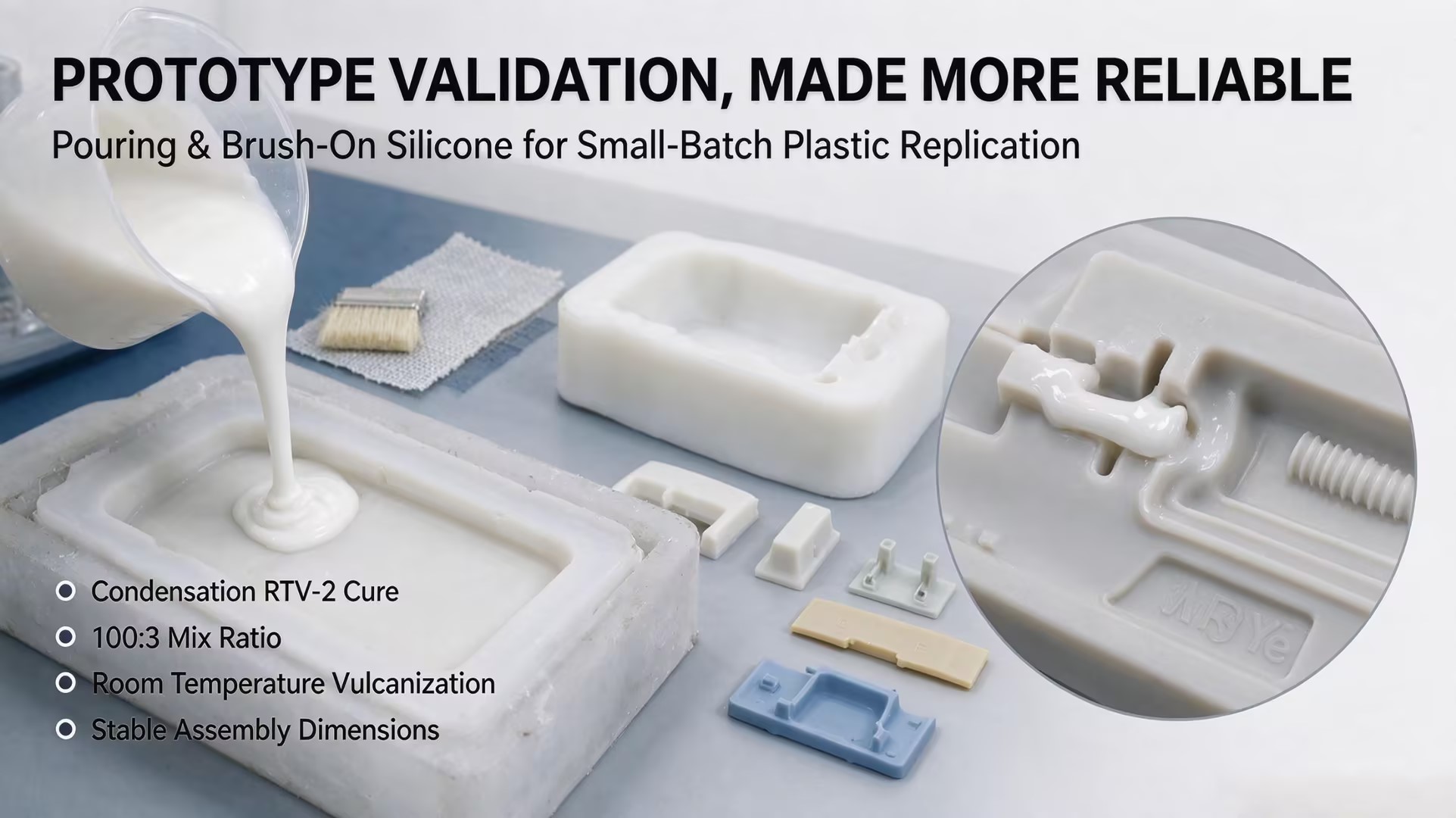
Industry trends show that new product R&D cycles keep shortening, and prototype orders are characterized by small batches, multiple versions and tight lead times. Many projects require multiple rounds of sample iteration within one week. Expensive steel molds are not suitable for frequent revision, while soft silicone molds stand out with low cost and fast delivery. Material suppliers keep optimizing formulations, offering grades with different hardness and pot life, together with complete test documents to meet compliance requirements for domestic and overseas prototype customers.

November 20, 2026

August 31, 2026

August 25, 2026

November 16, 2026

November 13, 2026
Email to this supplier
November 20, 2026
August 31, 2026
August 25, 2026
November 16, 2026
November 13, 2026
Privacy statement: Your privacy is very important to Us. Our company promises not to disclose your personal information to any external company with out your explicit permission.
Fill in more information so that we can get in touch with you faster
Privacy statement: Your privacy is very important to Us. Our company promises not to disclose your personal information to any external company with out your explicit permission.