Product Overview
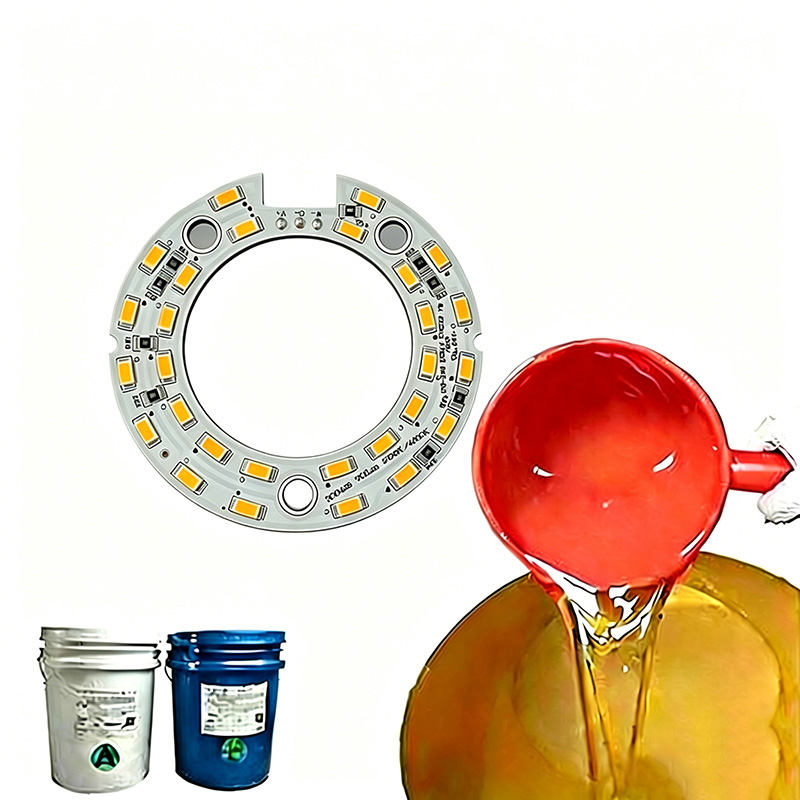
Our low-viscosity Electronic Potting Compound is a dual-component liquid material, with transparent Part A and customizable Part B. It is also called liquid tank jelly glue, with fluidity comparable to High transparency mold silicone. It is specially designed for precision electronic components, solving the problem of difficult pouring of dense elements, and ensuring full encapsulation and reliable protection.
Technical Specifications
A/B mixing ratio: 1:1 by weight; vacuum degassing for 3 minutes under 0.08MPa. Curing time: 3-8 hours (room temperature), 20 minutes (80~100℃). Low viscosity (easy to flow); shelf life: 1 year; packaging: 1-200KG/barrel; non-hazardous transportation. Compatible with various precision component materials.
Product Features
Ultra-low viscosity, flowing freely into tiny gaps without manual auxiliary filling. Fast defoaming, no bubble residue after pouring, ensuring insulation performance. Moderate softness after curing, no damage to precision components. It bonds firmly with metals and plastics, no shrinkage or oil leakage, and supports dual curing modes for flexible operation.
How to Use
1. Stir standing Part A and Part B to restore fluidity. 2. Mix evenly at 1:1 ratio, control stirring speed to avoid air mixing. 3. Degas briefly, then pour slowly along the edge of components. 4. Choose curing mode according to production speed.
Application Scenarios
Ideal for miniature LED modules, lamp strip PCBs, small intelligent control PCBs and precision electronic power modules. It is also suitable for liquid tank filter internal filling, improving construction efficiency and reducing production waste.
Certifications and Compliance
Meets electronic industry environmental protection and safety standards, supporting global small electronic product export.
Customization Options
Adjustable viscosity range to match different gap sizes of electronic components, optimizing fluidity for targeted needs.
Production Process
FAQ
Q: Can it fill gaps between dense SMT components?
A: Yes, ultra-low viscosity ensures no dead filling angle.
Q: Will bubbles appear inside after pouring?
A: Simple defoaming can achieve bubble-free encapsulation.














 Contact Now